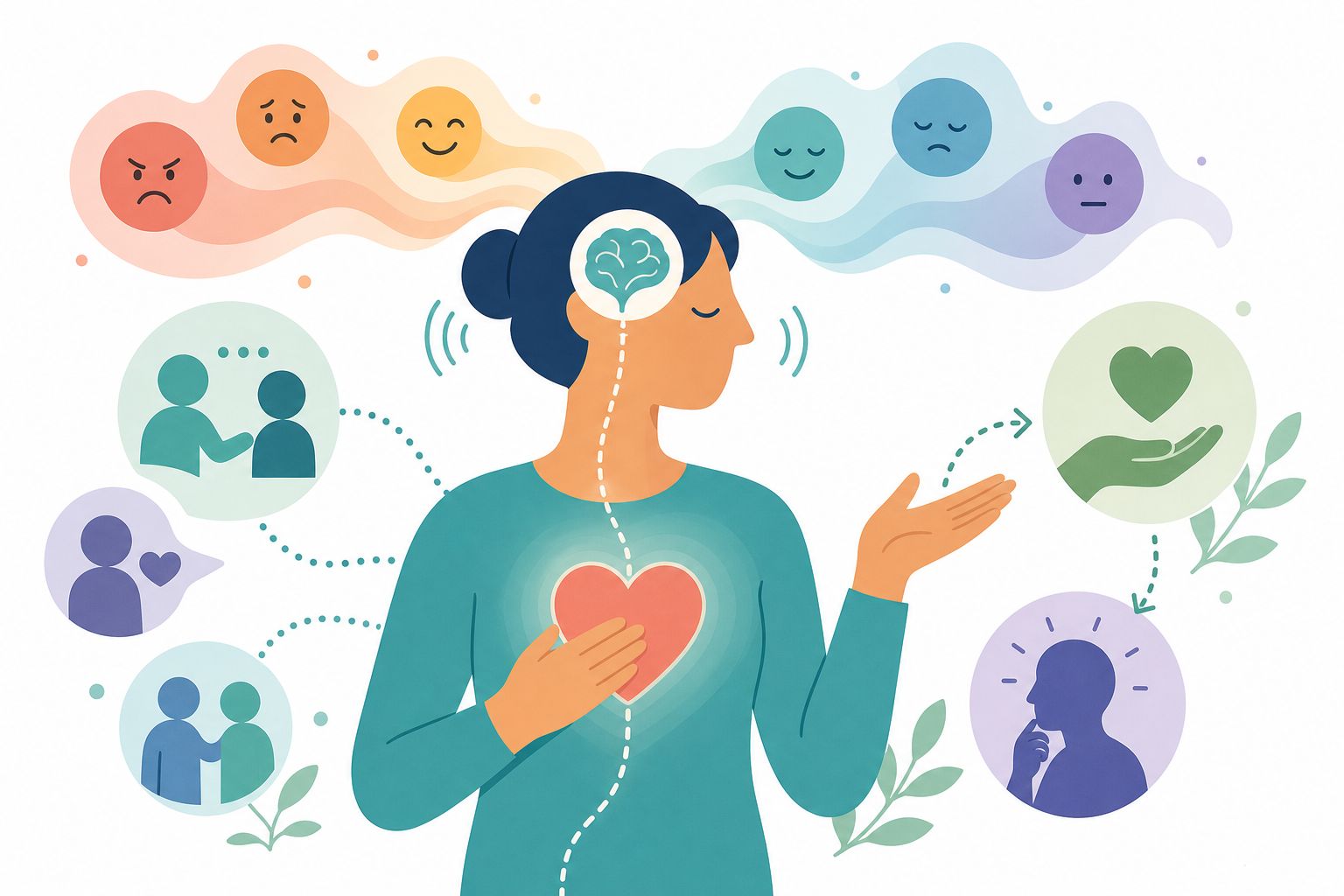
Emotional Intelligence Test: Do You Read Emotions Well?
Do you understand what you feel and why? Take this emotional intelligence test to explore how you notice and work with emotions.
Who Is This Test For?
This self-test is for adults who want a structured, non-clinical reflection on emotional intelligence using the full 33-item SSEIT.
- People curious about how they notice and use emotional information
- Anyone reflecting on empathy, social cues, motivation, and emotion regulation
- People who want a research-based self-report questionnaire without diagnostic wording
- Anyone exploring personal growth in relationships, work, study, or daily coping
Rate how much you agree with each statement. Answer based on your usual patterns, not what you think you should feel or do.
I know when to speak about my personal problems to others.
When I am faced with obstacles, I remember times I faced similar obstacles and overcame them.
I expect that I will do well on most things I try.
Other people find it easy to confide in me.
I find it hard to understand the non-verbal messages of other people.
Some of the major events of my life have led me to re-evaluate what is important and not important.
When my mood changes, I see new possibilities.
Emotions are some of the things that make my life worth living.
I am aware of my emotions as I experience them.
I expect good things to happen.
I like to share my emotions with others.
When I experience a positive emotion, I know how to make it last.
I arrange events others enjoy.
I seek out activities that make me happy.
I am aware of the non-verbal messages I send to others.
I present myself in a way that makes a good impression on others.
When I am in a positive mood, solving problems is easy for me.
By looking at their facial expressions, I recognize the emotions people are experiencing.
I know why my emotions change.
When I am in a positive mood, I am able to come up with new ideas.
I have control over my emotions.
I easily recognize my emotions as I experience them.
I motivate myself by imagining a good outcome to tasks I take on.
I compliment others when they have done something well.
I am aware of the non-verbal messages other people send.
When another person tells me about an important event in his or her life, I almost feel as though I have experienced this event myself.
When I feel a change in emotions, I tend to come up with new ideas.
When I am faced with a challenge, I give up because I believe I will fail.
I know what other people are feeling just by looking at them.
I help other people feel better when they are down.
I use good moods to help myself keep trying in the face of obstacles.
I can tell how people are feeling by listening to the tone of their voice.
It is difficult for me to understand why people feel the way they do.
Good To Know

Pause For One Emotion Word
Before reacting, name one feeling and one body signal. Simple labels like tense, hopeful, embarrassed, or relieved can make the next step clearer.

Check Cues Before Conclusions
When reading another person, separate what you observed from what you inferred. Facial expression, tone, and context are clues, not certainty.

Use Good Moods Deliberately
When you feel steady or encouraged, choose one useful task, kind message, or small plan. Positive emotion can support follow-through when used intentionally.
Understanding the SSEIT Score
T he Schutte Self-Report Emotional Intelligence Test is a 33-item self-report measure developed by Schutte and colleagues. It is also described in some sources as the SEIS or SREIS.
Each response is scored from 1 to 5, with items 5, 28, and 33 reverse-scored. The total score ranges from 33 to 165, with higher scores reflecting more self-reported emotional intelligence skills.
The developing, typical, and strong bands on this page are relative feedback ranges for reflection, not clinical cutoffs or official diagnostic categories. They are intended to make the score easier to understand without turning it into a label.
A reference average of 124 is shown for context only. Your score can be shaped by current stress, culture, relationship setting, mood, fatigue, and how comfortable you are with self-report questionnaires.
Frequently Asked Questions
Is the SSEIT a diagnosis?
No. The SSEIT is a self-report questionnaire for reflection and research use. It does not diagnose a mental health condition or determine your worth, maturity, or social ability.
Why are some items reverse-scored?
Items 5, 28, and 33 are phrased in the opposite direction. Reverse scoring keeps the total score consistent so that higher totals reflect more self-reported emotional intelligence skills.
What score range does this page use?
The full 33-item scale ranges from 33 to 165. This page uses relative bands of 33-110 developing, 111-136 typical, and 137-165 strong for supportive feedback.
What do SSEIT, SEIS, and SREIS mean?
SSEIT stands for Schutte Self-Report Emotional Intelligence Test. Some sources use related names or abbreviations such as SEIS or SREIS for the same Schutte self-report measure.
Can emotional intelligence change?
Many emotion-related skills can be practiced, including noticing feelings earlier, checking assumptions, listening for tone, repairing misunderstandings, and choosing supportive activities.
More Tests


This self-test is for education and reflection only. It is not a diagnosis, clinical assessment, or measure of personal worth. Scores can be influenced by current stress, culture, relationships, fatigue, and recent experiences.