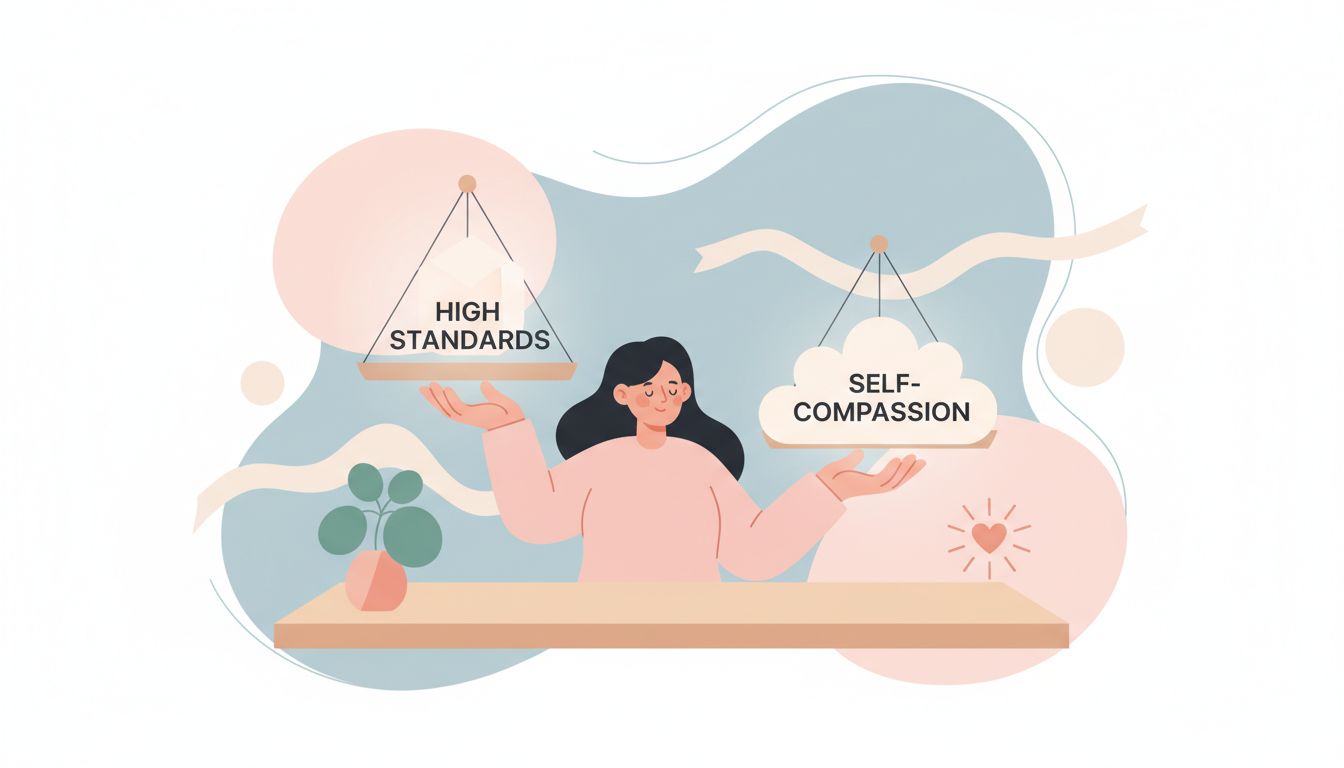
Perfectionism Test: Are Your Standards Too High?
Do your standards leave you tense or never satisfied? Take this perfectionism test to see how perfectionism may be shaping your daily life.
Who Is This Test For?
This perfectionism test is for people who want to understand whether their standards are motivating, distressing, or both. It is especially useful if achievement, order, mistakes, or self-criticism take up a lot of mental space.
- Adults and students who set high standards and struggle to feel satisfied
- People who procrastinate because starting or finishing imperfect work feels uncomfortable
- Those who overcheck, overprepare, or replay mistakes long after a task is done
- Anyone exploring links between perfectionism, anxiety, burnout, or self-criticism
Please read each statement and choose how much you agree or disagree.
I have high standards for my performance at work or at school.
I am an orderly person.
I often feel frustrated because I can't meet my goals.
Neatness is important to me.
If you don't expect much out of yourself, you will never succeed.
My best just never seems to be good enough for me.
I think things should be put away in their place.
I have high expectations for myself.
I rarely live up to my high standards.
I like to always be organized and disciplined.
Doing my best never seems to be enough.
I set very high standards for myself.
I am never satisfied with my accomplishments.
I expect the best from myself.
I often worry about not measuring up to my own expectations.
My performance rarely measures up to my standards.
I am not satisfied even when I know I have done my best.
I try to do my best at everything I do.
I am seldom able to meet my own high standards of performance.
I am hardly ever satisfied with my performance.
I hardly ever feel that what I've done is good enough.
I have a strong need to strive for excellence.
I often feel disappointment after completing a task because I know I could have done better.
Good To Know

Define 'Good Enough' First
Before starting a task, write down what finished means: time limit, required quality, and when you will stop. Perfectionism grows when the finish line moves. A clear stopping rule protects your energy and helps you practice trust.

Separate Standards from Self-Worth
A missed standard can mean the task was hard, the timeline was tight, or the method needs adjusting. It does not mean you are a failure. Try replacing 'I'm not good enough' with 'This result gives me information.'

Practice Small Imperfections
Flexibility grows through safe experiments. Send a low-stakes message without rereading it five times, leave a minor detail alone, or stop at 90 percent on a task that does not require perfection. Your nervous system learns from repetition.
Understanding the APS-R Perfectionism Test
T he Almost Perfect Scale-Revised (APS-R) was developed by Slaney, Rice, Mobley, Trippi, and Ashby to measure perfectionism as a multidimensional trait. Unlike simple 'are you a perfectionist?' quizzes, it separates high standards and order from the more distressing sense that your performance never matches what you expect of yourself.
The APS-R includes 23 statements rated from strongly disagree to strongly agree. Research commonly groups the items into three dimensions: Standards, Order, and Discrepancy. Standards reflects ambitious expectations, Order reflects preference for organization, and Discrepancy reflects the painful gap between standards and perceived performance.
This distinction matters because high standards are not automatically harmful. Many people value excellence, structure, and careful work. Perfectionism becomes more costly when high standards combine with chronic dissatisfaction, fear of mistakes, repeated checking, avoidance, or the feeling that nothing is ever good enough.
There is no universal clinical cutoff for perfectionism that applies to everyone. Your result should be read as a self-awareness guide, not a diagnosis. If perfectionism is causing anxiety, burnout, procrastination, relationship strain, or significant distress, consider discussing the pattern with a qualified mental health professional.
Frequently Asked Questions
Is perfectionism always bad?
No. High standards can support growth, skill, and meaningful achievement. The problem is not caring about quality; it is when your standards become rigid, your self-worth depends on performance, or you cannot feel satisfied even after real effort. The APS-R is useful because it separates striving from the distressing discrepancy component.
Can this test diagnose clinical perfectionism?
No. This is a self-assessment based on a validated research scale, not a diagnostic evaluation. Perfectionism can appear alongside anxiety, depression, OCD traits, eating concerns, and burnout, but only a qualified professional can evaluate those issues in context.
Why are there questions about order and neatness?
The APS-R treats order as one part of perfectionism. Some people express perfectionism through organization, neatness, and structure. Order is not necessarily harmful by itself; it becomes more relevant when it is paired with distress, rigidity, or the feeling that things must be exact before you can relax.
What should I do if my score is high?
Start by watching the moments when 'good enough' feels unsafe. Try setting a clear stopping rule before beginning a task, practice submitting or finishing imperfect work in low-risk situations, and use grounding or breathing when the urge to overcheck rises. If perfectionism is significantly affecting your life, therapy can help.
How often should I retake this test?
Perfectionism is a trait pattern, so it usually changes more slowly than daily mood. Retaking the test every few months can be useful if you are actively practicing new habits, working in therapy, or monitoring how pressure changes during school, work, or life transitions.
More Tests



Sources & References
- Slaney, R. B., Rice, K. G., Mobley, M., Trippi, J., & Ashby, J. S. (2001). The Revised Almost Perfect Scale. Measurement and Evaluation in Counseling and Development, 34, 130–145.
- Georgia State University CPY Rice Lab. APS-R and SAPS permissions and scoring FAQ.
- Rice, K. G., & Ashby, J. S. (2007). An efficient method for classifying perfectionists. Journal of Counseling Psychology, 54, 72–85.
This self-assessment is for education and self-reflection. It is not a diagnosis and cannot replace a professional evaluation. Perfectionism can overlap with anxiety, depression, OCD traits, eating concerns, and burnout. If your results reflect significant distress or impairment, consider speaking with a qualified mental health professional.