跳转到主要内容
简体中文

AnxietyAidTools

循证心理健康工具

Fight, Flight, Freeze: Your Alarm System Explained

A friendly explainer poster of the fight, flight, freeze, and fawn responses: your threat system as a smoke alarm, what each mode feels like from the inside, and what actually helps it switch off. Built for therapy rooms, classrooms, and fridge doors.

4 techniques
Free download
One page

Free download · PDF & PNG

Prints on one page - A4 and US Letter versions included

These cheat sheets are free for personal use, and therapists, counselors, and teachers are welcome to print and hand them out. Please keep the footer with the source on. If you share online, a link back to this page helps other people find the free version.

What's on this cheat sheet

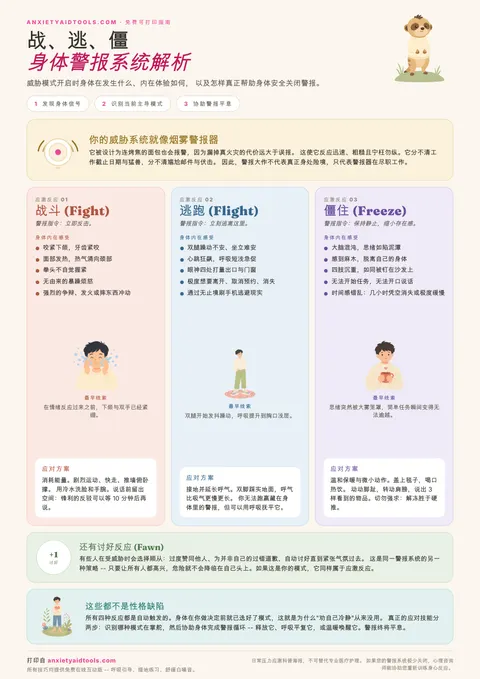
The smoke alarm

Why your threat system goes off for burnt toast: it is fast, sloppy, and better safe than sorry, and it cannot tell a deadline from a predator.

Fight

Clenched jaw, hot face, curling fists, and irritation spikes - plus what helps: burn it off with hard exercise, cold water, and space before words.

Flight

Restless legs, racing heart, scanning for exits, and the urge to leave or scroll away - plus what helps: grounding and longer exhales, because you cannot outrun an alarm.

Freeze

Fog, numbness, heavy limbs, and time going weird - plus what helps: gentle warmth and tiny movements like wiggling your toes and naming 3 objects, never forcing.

The fawn note

A small card on the fourth response: appeasing under threat through over-agreeing, apologizing, and people-pleasing. Same alarm, different strategy.

None are character flaws

A closing reminder that all four responses are automatic, and the real skill is noticing which one has the wheel, then helping the body finish the alarm.

How to use it

  1. 1

    Print it and put it where stressed people will actually see it: therapy room, classroom wall, fridge, or planner.

  2. 2

    When the alarm goes off, match your body signs to fight, flight, freeze, or fawn.

  3. 3

    Try the "what helps" move for that mode - burn it off, ground and exhale, or warm up slowly.

  4. 4

    Revisit it in calm moments so the labels are ready before you need them.

Frequently asked questions

What is the fight flight freeze response?

It is your body's automatic survival reaction to perceived threat, run by the nervous system before conscious thought gets a vote. Fight mobilizes you to push back, flight mobilizes you to escape, and freeze shuts things down to keep you still and small. All three are triggered by the same internal alarm, and that alarm fires just as readily for a deadline or an awkward conversation as it would for real physical danger.

What does freeze mode feel like?

Freeze usually feels foggy, numb, and heavy rather than panicky. Thoughts move through mud, your limbs feel glued down, starting a simple task or speaking up feels impossible, and time goes strange - hours can vanish or crawl. Many people mistake it for laziness or a character flaw, but it is a threat response: the body deciding that going still is the safest available option.

What is fawning?

Fawning is a fourth threat response where the body's strategy is to appease: over-agreeing, apologizing for things that are not your fault, and people-pleasing on autopilot until the tension passes. The logic is that if everyone around you is happy, the danger cannot land on you. It runs on the same alarm system as fight, flight, and freeze, and it is just as automatic - not a personality trait or a choice.

How do I get out of freeze mode?

Gently, and never by force. Freeze responds to warmth and tiny movements, not willpower: wrap up in a blanket or hold a warm drink, wiggle your toes, roll your shoulders, and name 3 objects you can see. Each small signal of safety and movement tells your nervous system the emergency is over. Pushing yourself hard usually deepens the shutdown, so think thaw, not shove.