דלג לתוכן הראשי
עברית

AnxietyAidTools

כלים לבריאות הנפש המבוססים על ראיות

Coping Skills for Kids

Eight playful coping skills written for kids ages 4 to 10, from balloon breathing to teddy breathing buddy, plus a quick-start strip for grown-ups. Print it, stick it on the fridge, and practice one together.

8 techniques
Free download
One page

Free download · PDF & PNG

Prints on one page - A4 and US Letter versions included

These cheat sheets are free for personal use, and therapists, counselors, and teachers are welcome to print and hand them out. Please keep the footer with the source on. If you share online, a link back to this page helps other people find the free version.

What's on this cheat sheet

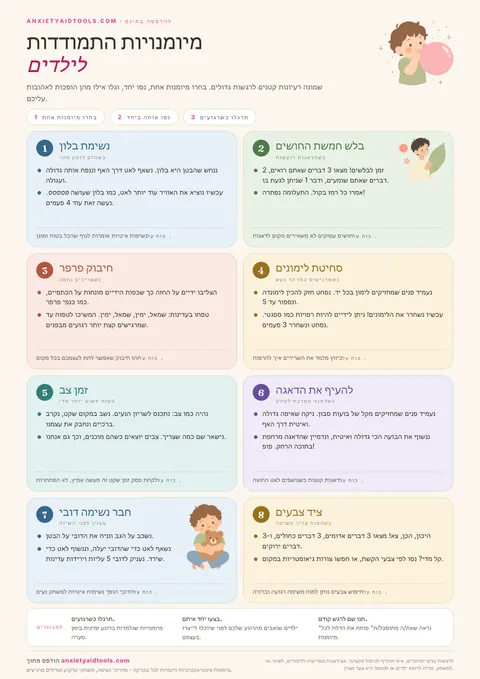
Balloon Breathing

Your belly becomes a balloon: blow it up slowly, then let the air out even slower. The long exhale is the part that actually calms a racing little heart.

The 5 Senses Detective

A grounding game in disguise: hunt for 3 things you can see, 2 you can hear, and 1 you can touch. Busy senses leave no room for loud worries.

Butterfly Hug

Arms crossed over the chest, hands on shoulders, slow left-right taps like butterfly wings. A self-soothing hug kids can give themselves anywhere.

Squeeze the Lemons

Squeeze imaginary lemons as tight as possible, count to 5, then drop them and go floppy. Simple progressive muscle relaxation dressed up as lemonade-making.

Turtle Time

Permission to retreat: tuck into a cozy shell in a quiet spot and come out when ready. Frames a needed break as brave, not as hiding.

Blow the Worry Away

Pretend bubbles: one big slow breath in, then the biggest, slowest bubble out with the worry floating away inside it. A sneaky way to stretch the exhale.

Teddy Breathing Buddy

A stuffed animal rides the belly up and down for 5 slow breaths. Watching teddy move turns belly breathing into a game, and it works beautifully at bedtime.

Color Hunt

Find 3 red things, 3 blue things, 3 green things. Giving an anxious brain a small concrete job pulls attention out of the worry and into the room.

How to use it

  1. 1

    Print the sheet and hang it somewhere your child can reach: the fridge, their bedroom door, or a calm-down corner.

  2. 2

    Practice one or two skills together while your child is already calm, so the moves feel familiar before a hard moment.

  3. 3

    When big feelings show up, name the feeling first, then offer a choice of two skills instead of a command.

  4. 4

    Do the skill with your child every time at first; kids borrow a grown-up's calm long before they can make their own.

Frequently asked questions

What are good coping skills for kids?

The best coping skills for kids are short, physical, and playful: slow belly breathing (balloon breathing or a teddy riding the belly), sensory grounding games like a 5 senses hunt or a color hunt, muscle release like squeezing pretend lemons, and self-soothing touch like the butterfly hug. Young children calm down through their bodies, not through logic, so skills that involve breath, movement, or the senses work far better than being told to relax. This sheet collects eight of these, each written as a game a child aged roughly 4 to 10 can actually follow.

How do I teach my child coping skills?

Three things matter most. First, practice when your child is already calm: a skill rehearsed during playtime is available during a meltdown, but a skill introduced mid-meltdown usually is not. Second, do it with them rather than instructing from across the room; co-regulation is how children learn to settle, and your slow breathing is the model their body copies. Third, name the feeling before offering a skill, since a child who feels understood is far more willing to try something. Keep it light and short, and let your child pick favorites.

What coping skills can kids use at school?

The most school-friendly skills are the quiet, invisible ones. The butterfly hug looks like crossed arms, balloon breathing is silent, and the 5 senses detective or a color hunt can be played from a desk without anyone noticing. Squeeze the lemons works as simply squeezing fists under the desk. It helps to rehearse at home which skill your child would use at school and when, and to let their teacher know your child has a go-to calm-down plan so a quick quiet minute is supported rather than questioned.

At what age can kids learn coping skills?

Simple body-based skills work from around age 3 to 4: toddlers can blow pretend bubbles, hug themselves like a butterfly, or curl up like a turtle with an adult guiding every step. Around ages 5 to 7, kids can start choosing a skill from a visual menu like this sheet with a reminder. By ages 8 to 10, many children can notice a big feeling rising and pick a skill on their own, though they still do best with warm backup. At every age the pattern is the same: an adult does it with them long before they do it alone.

More cheat sheets

Matching worksheets