Health Anxiety Cheat Sheet
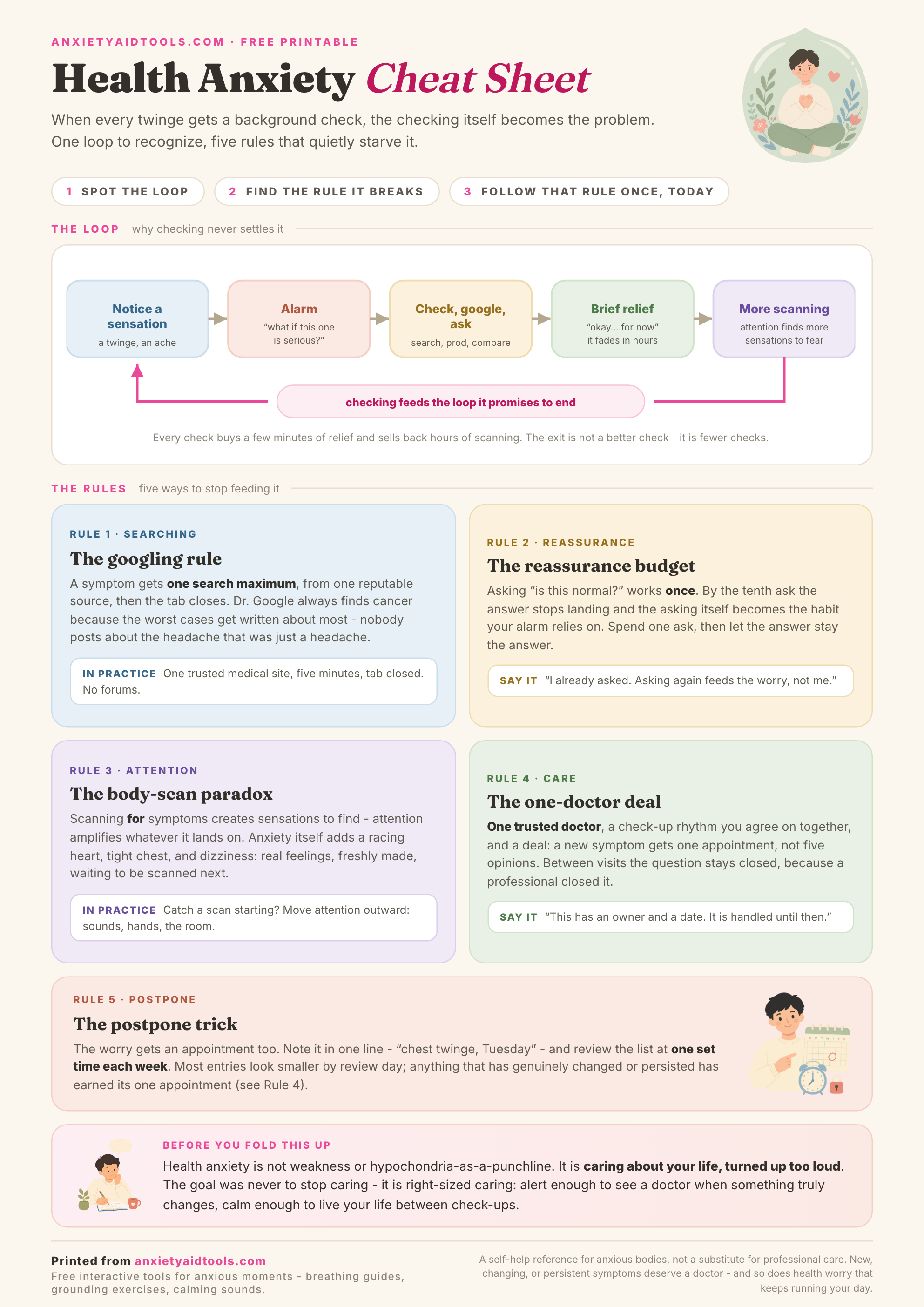
A one-page reference that maps the health anxiety loop - sensation, alarm, checking, brief relief, more scanning - and gives you five rules that stop feeding it. Includes the googling rule, the reassurance budget, the body-scan paradox, the one-doctor deal, and the postpone trick.
Free download · PDF & PNG
Prints on one page - A4 and US Letter versions included
These cheat sheets are free for personal use, and therapists, counselors, and teachers are welcome to print and hand them out. Please keep the footer with the source on. If you share online, a link back to this page helps other people find the free version.
What's on this cheat sheet
The loop
A five-step diagram of why checking never settles it: notice a sensation, alarm, check and google, brief relief, then more scanning that finds more sensations. Every check buys minutes of relief and sells back hours of scanning.
The googling rule
A symptom gets one search maximum, from one reputable source, then the tab closes. Search results skew terrifying because worst cases get written about most; nobody posts about the headache that was just a headache.
The reassurance budget
Asking 'is this normal?' works once. By the tenth ask the answer stops landing and the asking itself becomes the habit, so you spend one ask and let the answer stay the answer.
The body-scan paradox
Scanning for symptoms creates sensations to find, because attention amplifies whatever it lands on. Anxiety itself adds a racing heart, tight chest, and dizziness - real feelings that then get scanned next.
The one-doctor deal
One trusted doctor, a check-up rhythm you agree on together, and a deal: a new symptom gets one appointment, not five opinions. Between visits the question stays closed because a professional closed it.
The postpone trick
The worry gets an appointment too. Note it in one line and review the list at one set time each week; most entries look smaller by review day, and anything that has genuinely persisted has earned its one appointment.
A note on right-sized caring
A closing reminder that health anxiety is caring about your life turned up too loud. The goal is right-sized caring: alert enough to see a doctor when something truly changes, calm enough to live between check-ups.
How to use it
- 1
Print the sheet and keep it where the checking usually happens: next to your laptop, in a drawer by the mirror, or folded in a wallet.
- 2
When a sensation sets off the alarm, find yourself on the loop diagram first - naming the step you are on already loosens its grip.
- 3
Pick the rule the urge is about to break (googling, asking, scanning) and follow that one rule once, today.
- 4
Use the postpone trick for everything else: one line in a note, one weekly review time, and one doctor for anything that persists.
Frequently asked questions
How do I stop worrying about my health?
Start by changing what you do, not what you think: health worry is kept alive by checking, googling, reassurance seeking, and body scanning, so the fastest lever is cutting those behaviors down. Give a symptom one search from one reputable source, spend one ask of a trusted person, and book everything else into a single weekly review time instead of ruminating on the spot. Agree on a check-up rhythm with one doctor so new symptoms get one appointment rather than an open-ended investigation. The worry does not vanish overnight, but every check you skip teaches your alarm system that the sensation was survivable without it.
Why do I always think something is seriously wrong with me?
Because an anxious brain does two very normal things at once: it interprets ordinary sensations catastrophically, and it pays extremely close attention to the body. Attention amplifies whatever it lands on, so the twinge you monitor feels louder every hour, and anxiety itself produces real symptoms - racing heart, tight chest, dizziness - which then look like more evidence. That is not you being irrational or dramatic; it is a protection system running too hot. The loop diagram on this sheet exists precisely so you can catch that machinery in motion and treat the alarm as a signal about anxiety, not about disease.
Should I google my symptoms?
One careful search is reasonable; the fifth is fuel. Search results skew toward the terrifying because rare and severe cases get written about far more than boring ones, so Dr. Google structurally over-diagnoses - nobody writes a post about the headache that was just a headache. This sheet's googling rule keeps the useful part and drops the harmful part: one symptom, one search maximum, one reputable medical source, then the tab closes. If what you read genuinely warrants action, that action is booking an appointment with your doctor, not opening another tab.
When is health anxiety worth treating professionally?
When the checking, googling, reassurance seeking, or appointment-hopping starts eating your time, sleep, money, or relationships, or when you cannot stop even though you can see the loop clearly. Frequent doctor visits that never settle the fear, avoiding medical care entirely, or dread that returns within days of a clear test result are all classic signs. Health anxiety responds well to treatment, especially CBT, so seeking help is not an admission that something is wrong with you - it is the one-doctor deal applied to the worry itself. A printable sheet can support that work, but it is not a substitute for it.