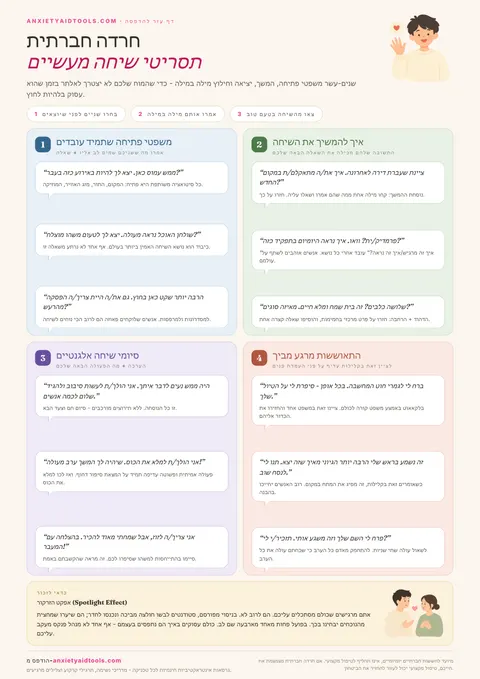
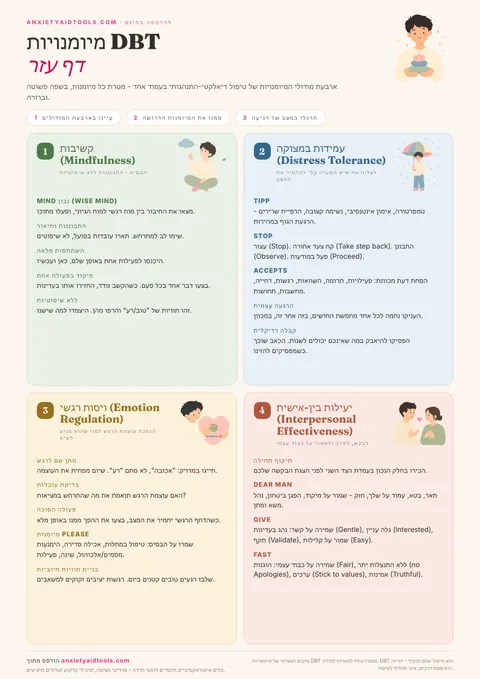
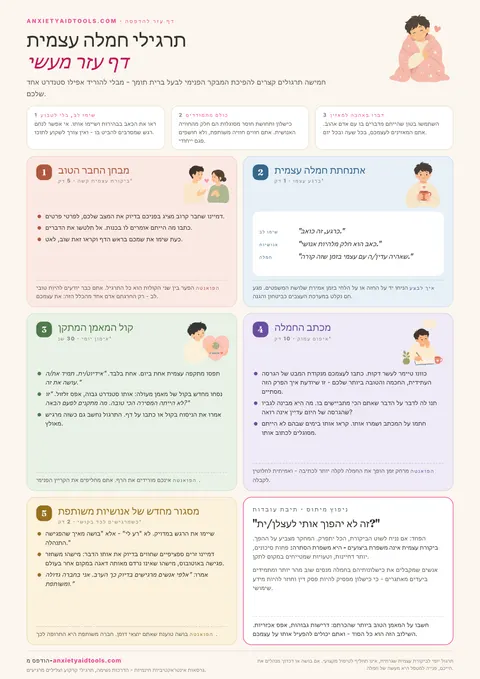
דלג לתוכן הראשי
עברית

AnxietyAidTools

כלים לבריאות הנפש המבוססים על ראיות

Boundary Setting Scripts Cheat Sheet

Ten word-for-word boundary scripts for the places saying no feels hardest: work requests, family comments, group chats, and the moment someone pushes back. Print it, pick your line, and let the wording be one thing you don't have to invent under pressure.

10 techniques
Free download
One page

Free download · PDF & PNG

Prints on one page - A4 and US Letter versions included

These cheat sheets are free for personal use, and therapists, counselors, and teachers are welcome to print and hand them out. Please keep the footer with the source on. If you share online, a link back to this page helps other people find the free version.

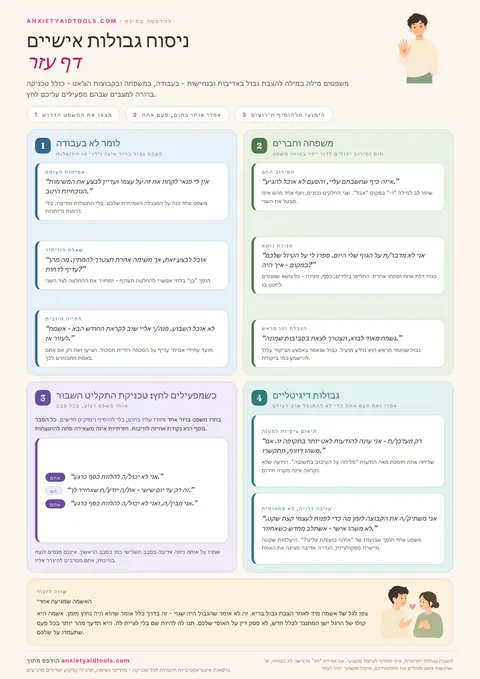
What's on this cheat sheet

Saying no at work

Three scripts for workload limits: the capacity truth, the trade-off question that hands prioritization back ('which of these should move?'), and the not-never that offers a real later instead of a resentful now.

Family and friends

Three scripts for the people closest to you: a warm no that skips the excuse, a topic close that redirects comments about your body, kids, or money, and a visit limit named in advance so it lands as information, not rejection.

The broken record

The one technique for pushback: repeat the same calm sentence each round without adding new justifications. Includes a three-line example exchange showing exactly how it sounds in a real conversation about lending money.

Digital boundaries

Two scripts for your phone: a reply-time reset that replaces a hundred apologies for late responses, and a leave-loudly line for stepping back from a group chat without anyone wondering if you're angry.

The guilt that follows

A short reframe for the wave of guilt that arrives right after a healthy boundary: it usually means the boundary was overdue, not wrong, and it fades faster every time you hold the line.

How to use it

  1. 1

    Print the sheet and read it somewhere calm, before you need it, not mid-confrontation.

  2. 2

    Pick the one script that matches the conversation you're dreading and practice saying it out loud once.

  3. 3

    Deliver the line warmly, then stop talking - resist the urge to stack extra reasons on top.

  4. 4

    If they push back, switch to the broken record: same calm sentence, every round, and reread the guilt note afterward.

Frequently asked questions

How do I set boundaries without feeling guilty?

You mostly can't, at first, and that's worth knowing in advance. Guilt after a healthy boundary is not evidence you did something wrong; it's the sound of an old habit objecting to a new rule, and it often shows up precisely because the boundary was overdue. The workable goal is to set the boundary while the guilt is present, rather than waiting for a guilt-free version of yourself to do it. Each time you hold the line and nothing terrible happens, the guilt arrives smaller and leaves sooner.

What do I say to set a boundary?

Almost every good boundary line has the same three-part shape: say what you will or won't do, add genuine warmth, and stop before you start over-explaining. 'I love that you thought of me, and I can't make it this time' does all three in one sentence. The warmth signals the relationship is fine; the plain statement carries the limit; the missing paragraph of justifications is what keeps it from turning into a negotiation. If a script on this sheet feels stiff, keep the shape and swap the words for ones that sound like you.

Why do people get angry when I set boundaries?

Usually because your old yes was an arrangement that worked well for them, and your new limit just cancelled it without their vote. The people who push back hardest are often the ones who benefited most from you having no limits, so their frustration is a measure of what they're losing, not of whether you were wrong. Most people adjust within a few repetitions, especially if your tone stays warm while your sentence stays the same. Someone's disappointment is real and allowed; it just isn't a veto.

What if someone ignores my boundary?

Remember that a boundary describes your action, not their compliance, so it can't actually be ignored out of existence. If you said you're heading out by eight, the boundary isn't them agreeing to that; it's you putting your coat on at eight. Restate the line once, calmly, using the broken record technique, and then follow through on your side: leave on time, mute the chat, change the subject, decline the task. People learn quickly that your sentences mean something when the sentence and the action keep matching.