10 min

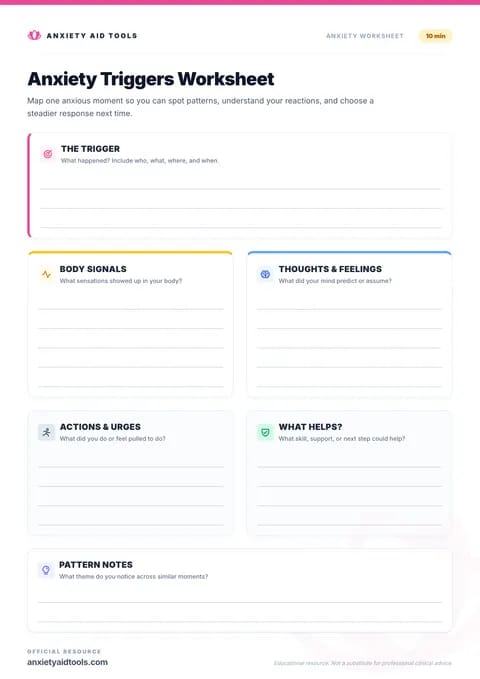
Anxiety Triggers Worksheet

A simple anxiety trigger tracker for mapping situations, body signals, thoughts, actions, and helpful responses.

Anxiety & Worry
Beginner
10 min

The Anxiety Triggers Worksheet helps you slow down one anxious moment and see its parts more clearly. A trigger is not always a single obvious event. It can be a place, conversation, task, memory cue, body sensation, deadline, or pattern that your mind reads as threatening or uncertain.

This worksheet maps the sequence from trigger to body signals, thoughts and feelings, actions or urges, and what helps. Seeing the chain on paper can reduce confusion and make the next helpful step easier to choose.

Use it after a stressful moment or during a calm review of recent anxiety. Over time, repeated entries can reveal themes: certain times of day, types of conversations, physical cues, avoidance patterns, or coping skills that reliably help you return to steadiness.
Anxiety Triggers Worksheet

Anxiety Triggers Worksheet

A simple anxiety trigger tracker for mapping situations, body signals, thoughts, actions, and helpful responses.

When to Use

  • After an anxious moment to understand the sequence
  • When anxiety feels random or unpredictable
  • Before therapy to bring clear examples
  • When building a personal coping plan

How to Use

  1. 1
    Choose one recent anxious moment rather than a whole week.
  2. 2
    Write the trigger using plain observable details.
  3. 3
    List body signals, thoughts, feelings, actions, and urges.
  4. 4
    Identify what helped, even if it helped only a little.
  5. 5
    Look for one pattern across similar situations.
  6. 6
    Choose one small response to test next time.

Research & References

  • Barlow, D. H. (2002). Anxiety and Its Disorders: The Nature and Treatment of Anxiety and Panic. Guilford Press.
  • Centre for Clinical Interventions (2022). Vicious Cycle of Anxiety. CCI Self-Help Resources.