Self-Esteem Boosters Cheat Sheet
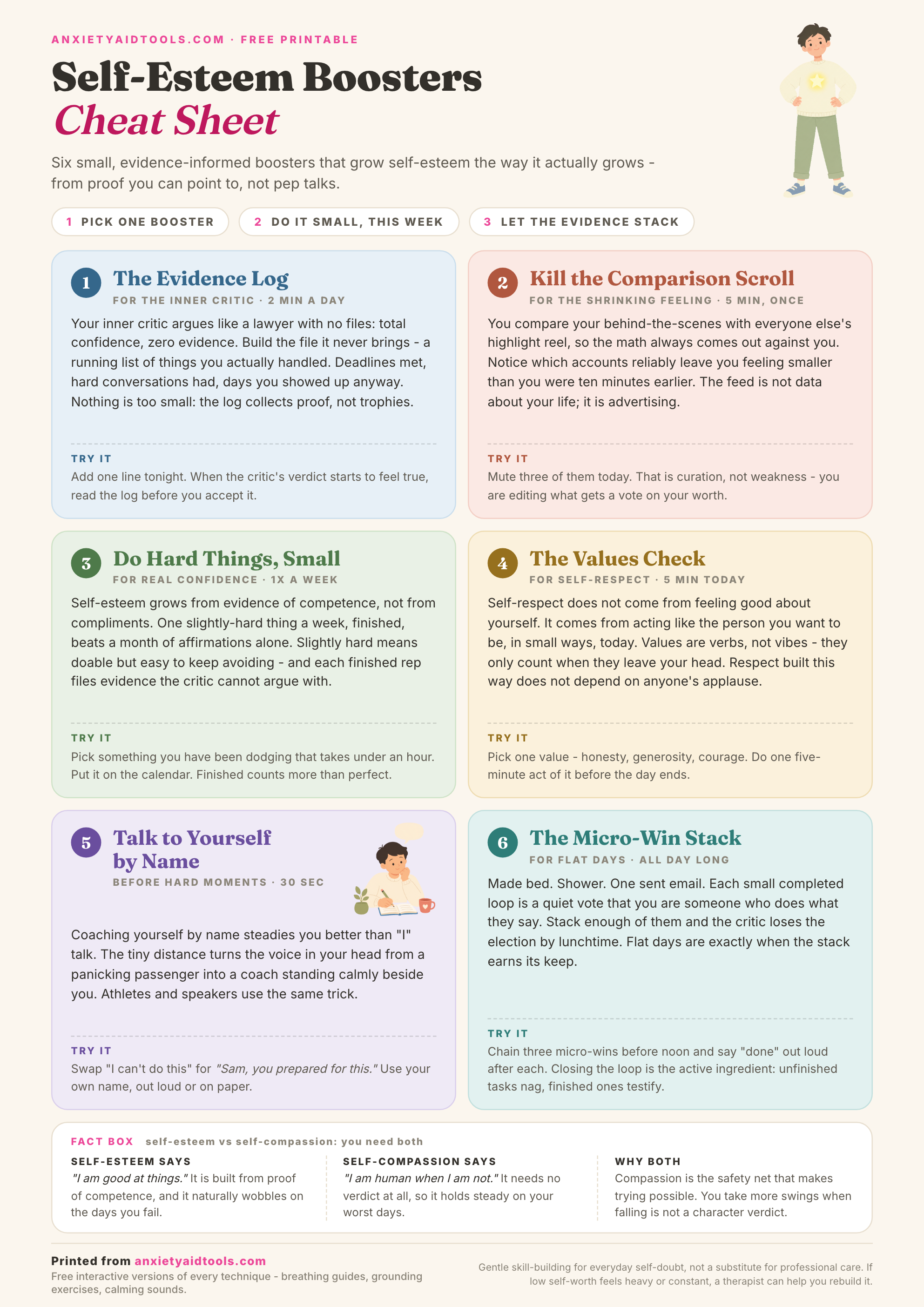
Six small, evidence-informed activities that build self-esteem from proof, not pep talks - an evidence log, tiny finished challenges, values in action, and more. One printable page you can start using tonight.
Free download · PDF & PNG
Prints on one page - A4 and US Letter versions included
These cheat sheets are free for personal use, and therapists, counselors, and teachers are welcome to print and hand them out. Please keep the footer with the source on. If you share online, a link back to this page helps other people find the free version.
What's on this cheat sheet
The Evidence Log
Your inner critic is a lawyer with no files. Keep a running list of things you actually handled and read it back when the critic's verdict starts to feel true.
Kill the Comparison Scroll
You compare your behind-the-scenes with everyone else's highlight reel, so the math always goes against you. Mute the accounts that reliably shrink you - that is curation, not weakness.
Do Hard Things, Small
Self-esteem grows from evidence of competence, not compliments. One slightly-hard thing a week, finished, beats a month of affirmations alone.
The Values Check
Self-respect comes from acting like the person you want to be, in small ways, today. Pick one value and do one five-minute act of it before the day ends.
Talk to Yourself by Name
Distanced self-talk steadies you better than "I" talk: coaching yourself by name puts an inch of space between you and the panic, the way athletes do before big moments.
The Micro-Win Stack
Made bed, shower, one sent email: small completed loops all day are quiet votes that you do what you say. Stack enough and they outvote the critic.
Fact Box: Self-Esteem vs Self-Compassion
Esteem says "I am good at things"; compassion says "I am human when I am not." You need both - compassion is the safety net that makes trying possible.
How to use it
- 1
Print the sheet and keep it where self-doubt tends to find you - desk, journal, or bedside table.
- 2
Pick one booster, not all six; small and actually done beats ambitious and abandoned.
- 3
Do it at the size printed on the card - one log line, one mute, one five-minute act.
- 4
Repeat for a couple of weeks and let the evidence stack before you judge whether it is working.
Frequently asked questions
How do I build self-esteem?
Mostly through evidence, not mantras. Self-esteem responds to two inputs: proof of competence, which you get by doing slightly-hard things and finishing them, and the tone of your self-talk, which you can retrain with practices like distanced self-talk and an evidence log. Affirmations alone tend to bounce off, and can even backfire when they contradict what you currently believe about yourself. The reliable path is small and repetitive: one finished challenge a week, one logged win a day, and a steadily kinder inner voice narrating both.
Why is my self-esteem so low?
Low self-esteem is usually learned, not innate. Common sources include a critical or unpredictable environment growing up, bullying or exclusion, perfectionist standards that make every result a failure, and years of unanswered inner criticism that hardened into a default voice. Constant social comparison, especially online, keeps the wound open. Depression and anxiety also distort self-perception, so low self-worth can be a symptom as much as a cause. None of this means the verdict is accurate - it means the evidence was gathered by a biased witness, and it can be re-examined.
What is the difference between self-esteem, self-confidence, and self-compassion?
Self-esteem is your overall sense of worth as a person; self-confidence is your trust in your ability to do specific things, so you can be a confident pianist with low self-esteem or the reverse. Self-compassion is different from both: it is how you treat yourself when things go badly, and it requires no positive verdict at all. That makes it the most stable of the three, because it does not collapse on the days you fail. In practice they feed each other - compassion makes failure survivable, which makes you attempt more, which builds the competence that esteem and confidence are made of.
Does social media lower self-esteem?
It can, and the mechanism is comparison. Feeds show you other people's highlight reels - curated wins, filtered photos, announced promotions - which your brain compares against your own unedited daily experience. Research links heavy passive scrolling, the kind where you watch others' lives without interacting, to lower mood and self-evaluation, while active use with real connection looks more neutral. The dose and the diet both matter: the same platform feels different when you mute the accounts that reliably shrink you and follow ones that do not. Curating your feed is not fragility; it is choosing what gets a vote on your worth.