Guided Imagery Scripts Cheat Sheet
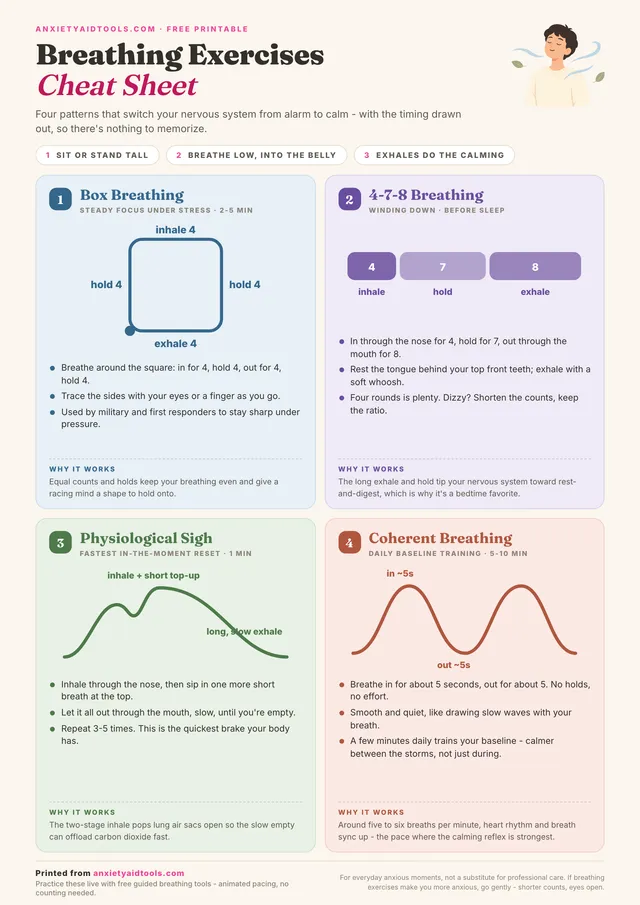
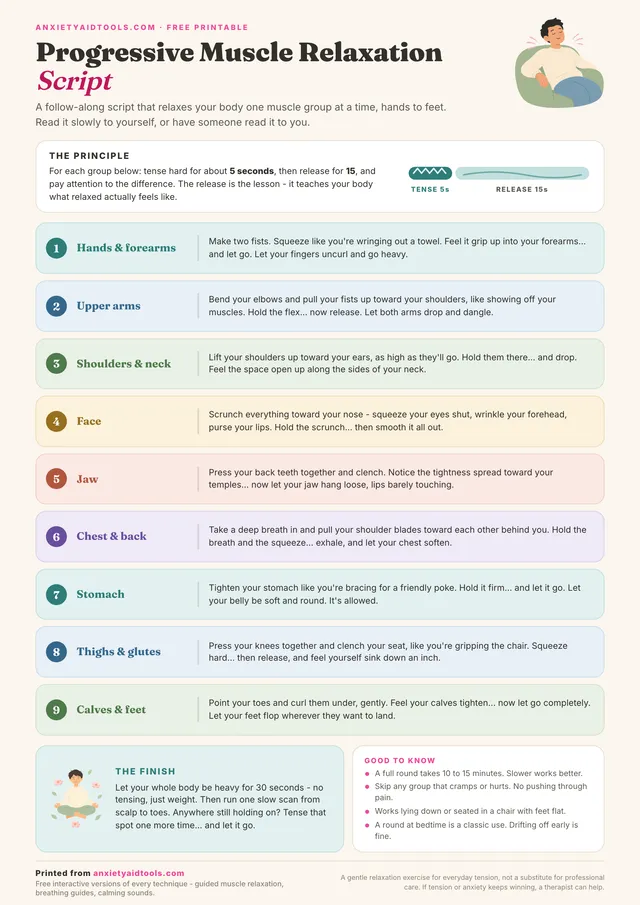
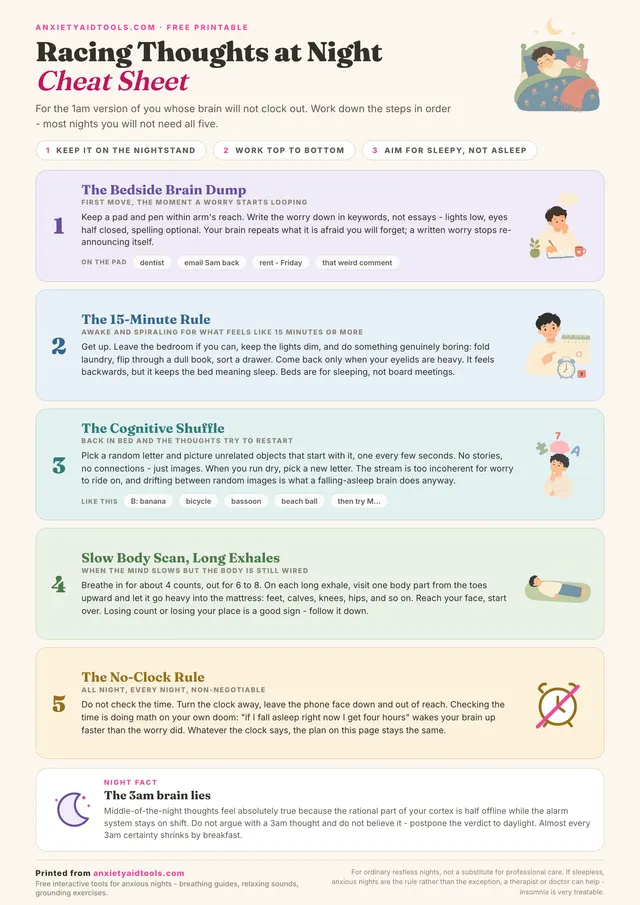
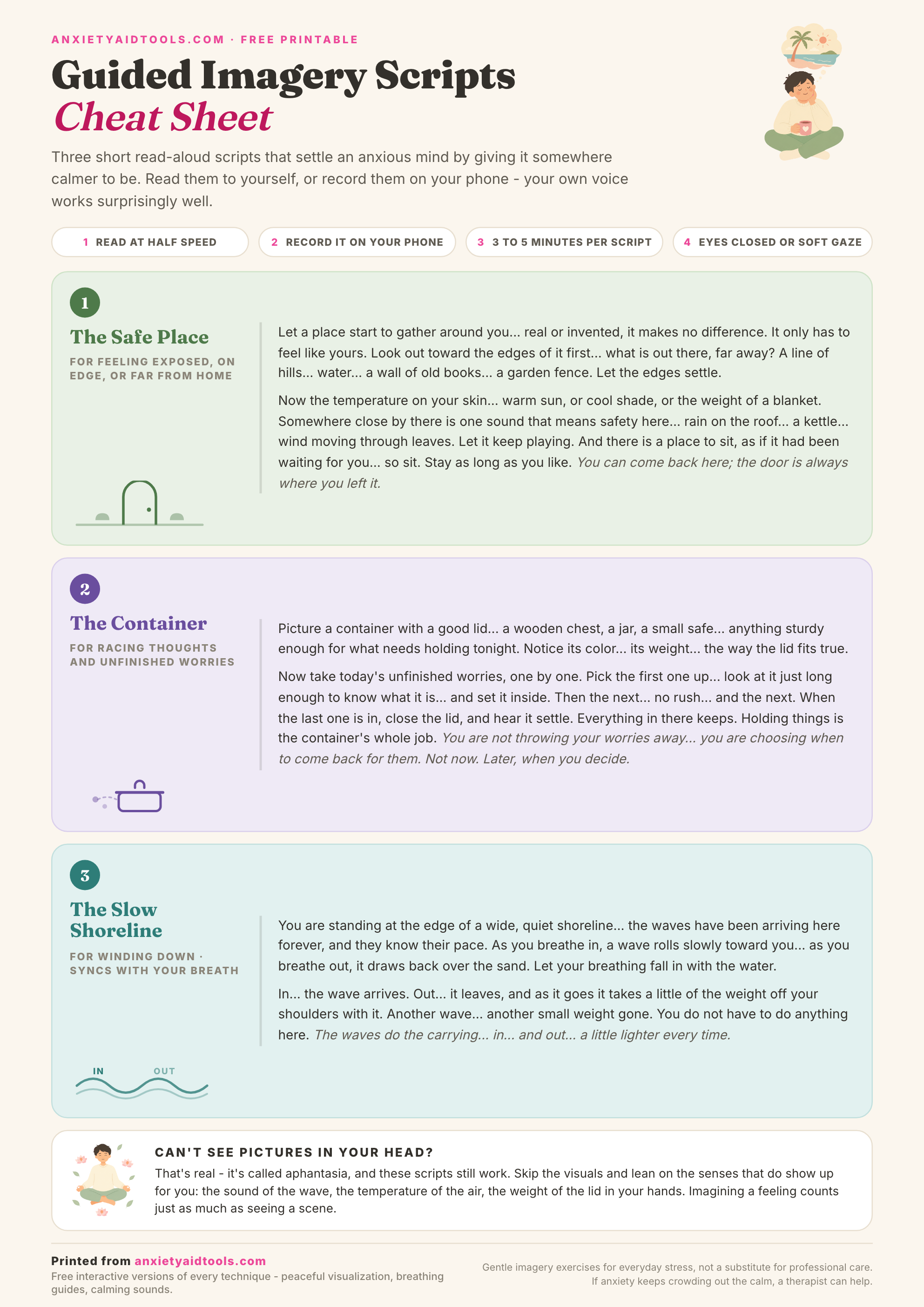
Three short read-aloud visualization scripts written as flowing spoken text: build a safe place sense by sense, put unfinished worries in a container with a good lid, and sync your breath to slow waves. Read them slowly, or record them once on your phone and press play.
Free download · PDF & PNG
Prints on one page - A4 and US Letter versions included
These cheat sheets are free for personal use, and therapists, counselors, and teachers are welcome to print and hand them out. Please keep the footer with the source on. If you share online, a link back to this page helps other people find the free version.
What's on this cheat sheet
The Safe Place
A script that builds a place, real or invented, sense by sense: what sits at the edges, the temperature on your skin, the one sound that means safety, and a place to sit. It closes with a line worth keeping: you can come back here; the door is always where you left it.
The Container
A classic therapy tool. Picture a container with a good, sturdy lid, place today's unfinished worries inside one by one, and close it. Nothing is thrown away - you are choosing when to come back for them.
The Slow Shoreline
A breath-synced beach script: a wave rolls in as you inhale and draws back as you exhale, each one carrying a little more weight off your shoulders.
How to read them
Four quick pointers: read at half your natural speed, record yourself on your phone, give each script 3 to 5 minutes, and keep your eyes closed or on a soft gaze.
A note on aphantasia
If you cannot see pictures in your head, the scripts still work - lean on sound, temperature, and the feeling of weight instead of visuals.
How to use it
- 1
Print the sheet and pick the script that fits the moment: safe place for feeling on edge, container for racing thoughts, shoreline for winding down.
- 2
Read it out loud at half your natural speed, letting the ellipses be real pauses.
- 3
Better yet, record yourself reading it once on your phone, then press play with your eyes closed whenever you need it.
- 4
Give each script 3 to 5 minutes and repeat a favorite nightly until it starts working on cue.
Frequently asked questions
How does guided imagery reduce anxiety?
Your body responds to vividly imagined scenes much like it responds to real ones, which is why picturing a confrontation makes your heart race. Guided imagery uses that same wiring in your favor: a slow, detailed calm scene gives your nervous system safety signals to react to, easing muscle tension, heart rate, and breathing. Pairing the scene with slow breathing, as the shoreline script does, deepens the effect.
What is the safe place exercise?
It is one of the most widely used tools in therapy, especially in trauma work and EMDR. You build a place where you feel completely safe - real, invented, or a mix - and make it vivid one sense at a time: what you see at the edges, the temperature on your skin, one sound that means safety. With practice, returning to it takes seconds, and it becomes a reliable spot to steady yourself before or after something hard.
What if I can't visualize anything?
Some people genuinely cannot form mental pictures - it is called aphantasia, and it does not shut you out of these scripts. The visual channel is only one way in. Lean on the senses that do work for you: imagine the sound of the wave rather than the sight of it, the warmth of the sun on your skin, the weight of the container's lid in your hands. Imagining a feeling counts just as much as seeing a scene.
How long should guided imagery take?
Each script on this sheet runs about 3 to 5 minutes when read slowly, and slow is the point - aim for half the pace that feels natural, with real pauses at the ellipses. That is long enough for your body to start downshifting without demanding a big time commitment. For sleep or deeper relaxation you can stretch a script to 10 minutes, linger inside the scene, or run two back to back.