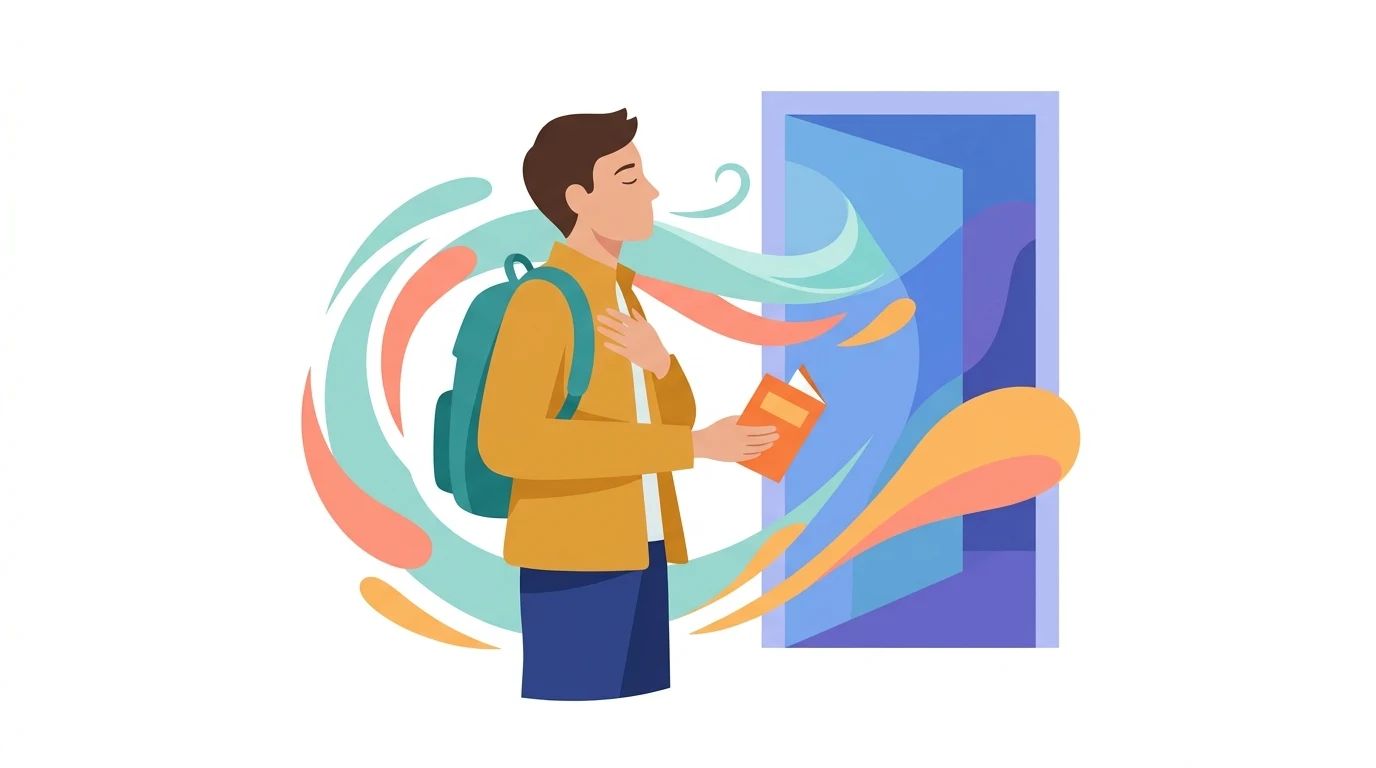
Test Anxiety Test: How Anxious Are You Before Exams?
Feel tense, worried, or physically uncomfortable before an exam? Take this test anxiety test to reflect on your current test-related reactions.
Who Is This Test For?
The STAS is for people who want to reflect on physical, cognitive, and social reactions around a particular exam or assessment. It can support personal reflection, preparation, or a conversation with a qualified professional.
- People who feel tense or physically uncomfortable before an exam
- Anyone who worries about time, answers, grades, or failure during an assessment
- People noticing concern about how family, teachers, or classmates may react
- Anyone tracking how test-related reactions change across different assessments
Think about the exam or assessment you are about to take and choose how much each statement describes how you feel right now.
I have difficulty breathing.
I have nausea.
I feel tense.
I am afraid of not being able to finish the exam on time.
I have a dry mouth.
I worry about someone other than me seeing my exam paper.
I am afraid of not being able to come up with the answers in the exam.
I have a stomachache.
I am afraid of not understanding what I read in the exam.
I worry about my classmates making fun of me for getting a low grade on the exam.
My muscles are more tense than usual.
I think my family will react negatively if I get a low grade on the exam.
I think I will lose face in my teacher's eyes if I get a low grade on the exam.
I am afraid of having difficulty remembering the answers in the exam.
I have a fever.
I am afraid of failing the exam.
I have a headache.
I will feel sad if I get a low grade on the exam.
I have stomach cramps.
I am afraid that my tension will cause my exam grade to decrease.
I worry about my classmates seeing my exam score.
I think I should have studied more for the exam.
Good To Know

Prepare One Small Next Step
Instead of trying to eliminate every anxious feeling, choose one concrete preparation action, such as reviewing one topic or packing what you need.
Practice Before the Exam
Try a short practice question under calm, realistic conditions so the exam routine feels more familiar and your attention has a clear starting point.
Use a Body Reset
Relax your shoulders, feel both feet on the floor, and take several slow breaths before returning to the question or task in front of you.
Understanding the STAS
T he State Test Anxiety Scale (STAS), also known as the DuSKÖ in its original Turkish form, is a 22-item measure of reactions connected with a particular exam or assessment. Alper Şahin developed the original Turkish scale, published in 2019, and validated an English adaptation in 2021. The original and English source articles are cited below and are available under a Creative Commons Attribution (CC BY) licence; this reproduction credits the author and sources.
The scale covers three related subscales: Physiological Effects (PE: items 1, 2, 5, 8, 11, 15, 17, and 19), Cognitive Effects (CE: items 3, 4, 7, 9, 14, 16, 18, 20, and 22), and Psychosocial Effects (PSE: items 6, 10, 12, 13, and 21). Each statement is rated from 1 (Not at all) to 4 (A lot), and all items are scored directly; there are no reverse-coded items.
Adding the 22 responses gives a total from 22 to 88. The descriptive ranges on this page divide that possible score range into less frequent (22–43), common (44–65), and more frequent (66–88) bands. The author expressly cautions that proposed halfway and two-thirds points have not been validated, so these bands are educational descriptions rather than validated thresholds, severity categories, or diagnoses.
The STAS is intended to reflect how you feel around a particular assessment, not to determine whether you have an anxiety disorder. Results can change with the exam, preparation, sleep, health, and setting. If test-related reactions cause significant distress or interfere with education or daily life, consider speaking with a qualified mental health professional.
Frequently Asked Questions
What does the STAS measure?
The STAS measures physical, cognitive, and psychosocial reactions connected with a particular exam or assessment. It is a state check-in, so answer about the situation you have in mind rather than treating it as a permanent personal characteristic.
How is the STAS scored?
Each of the 22 items is rated from 1 (Not at all) to 4 (A lot). Add all responses for a total from 22 to 88. Every item is scored directly, with no reverse coding.
What do the less frequent, common, and more frequent ranges mean?
They are descriptive score ranges for this self-reflection page: 22–43 less frequent, 44–65 common, and 66–88 more frequent. They are not validated cut points, clinical severity categories, or diagnostic results.
Can I take this test for different exams?
Yes. The STAS was designed to reflect state test anxiety around a particular exam. If you compare results, note which assessment you had in mind and remember that preparation, sleep, health, and the setting can affect a score.
What can I do if test anxiety is getting in the way?
Try a brief breathing or grounding exercise, break preparation into a concrete next step, and discuss practical support with a teacher, adviser, or qualified mental health professional. Seek professional support if reactions cause significant distress or interfere with daily life.
More Tests



This self-assessment is for education and self-reflection only. The less frequent, common, and more frequent bands are descriptive score ranges, not validated thresholds, clinical severity categories, or a diagnosis. STAS item wording and direct scoring are reproduced from Şahin (2019), State Test Anxiety Scale (DuSKÖ), and Şahin (2021), Validation of a new State Test Anxiety Scale (STAS), under the authors' Creative Commons Attribution (CC BY) licence; this page credits the author and source articles. This page cannot replace an evaluation by a qualified mental health professional. If test-related reactions cause significant distress or affect daily functioning, consider seeking professional support. If you are in immediate danger or crisis, contact emergency services or a crisis hotline now.