मुख्य सामग्री पर जाएं
हिन्दी

AnxietyAidTools

साक्ष्य-आधारित मानसिक स्वास्थ्य उपकरण

Stress Relief Techniques Cheat Sheet

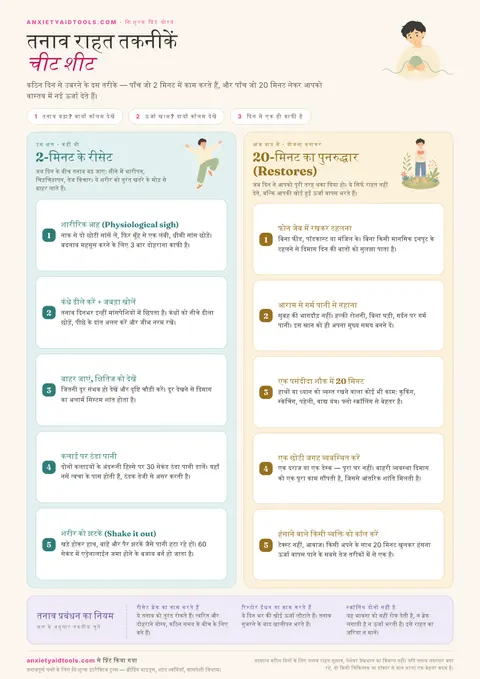
Ten stress relief techniques on one printable page: five 2-minute resets that stop a spike in the moment, and five 20-minute restores that refill what the day drained. The rule of thumb at the bottom helps you match the tool to the moment.

10 techniques
Free download
One page

Free download · PDF & PNG

Prints on one page - A4 and US Letter versions included

These cheat sheets are free for personal use, and therapists, counselors, and teachers are welcome to print and hand them out. Please keep the footer with the source on. If you share online, a link back to this page helps other people find the free version.

What's on this cheat sheet

2-Minute Resets

Five techniques for the middle of a stressful moment: the physiological sigh, a shoulder-drop and jaw-unclench scan, stepping outside to find the horizon, cold water on the wrists, and shaking out your limbs. Each one works on the body directly, so it helps even when you cannot think your way calm.

20-Minute Restores

Five deeper activities for the end of a draining day: a real walk with your phone in your pocket, a hot shower or bath treated as a ritual, one absorbing hobby block, tidying one small area, and calling someone who makes you laugh. These refill the tank rather than just pausing the leak.

The stress rule of thumb

A bottom strip that explains when to use which column: resets are brakes that stop a spike, restores are fuel that puts back what the day drained, and scrolling is neither - it holds the feeling still without braking or refilling anything.

How to use it

  1. 1

    Print the sheet and put it somewhere you will actually see it: your desk, the fridge, or inside a planner.

  2. 2

    When stress spikes mid-day, pick one technique from the left column and do it fully rather than halfway.

  3. 3

    Once a day, give yourself one 20-minute restore from the right column - scheduled, not squeezed in.

  4. 4

    When you are not sure what you need, use the rule of thumb at the bottom: spiking means brakes, empty means fuel.

Frequently asked questions

How can I relieve stress quickly?

Go through the body, not the thoughts. The fastest reliable techniques are physical: a physiological sigh (two inhales through the nose, one long exhale through the mouth), cold water on your wrists or face, dropping your shoulders and unclenching your jaw, or sixty seconds of shaking out your arms and legs. These work in about two minutes because they act on the same nervous system that produced the stress response, so they help even when your mind is too busy to reason with. Repeat the technique once or twice if the first round only takes the edge off.

What actually reduces stress?

It helps to separate two different jobs. Quick techniques like breathing, cold water, and movement reduce the acute spike - the surge of adrenaline in a hard moment - but they do not change how stressed you are overall. Your baseline comes down through restorative activities done regularly: phone-free walks, absorbing hobbies, real rest, laughter with people you like, plus the fundamentals of sleep and exercise. Most people only ever use spike tools and then wonder why they still feel fried; lowering the baseline is a separate practice, and it is the one that compounds.

Why doesn't scrolling relax me?

Scrolling distracts you from stress without discharging it. Your body stays in the same keyed-up state - often slightly more alert, because feeds are built from novelty and your attention keeps bracing for the next thing. It also does not restore anything: no movement, no completion, no connection, no rest. That is why an hour of scrolling can leave you feeling both unrelaxed and vaguely worse, while twenty minutes of walking or cooking leaves you noticeably better. Scrolling is fine as a pause; it just cannot do the job of an actual reset or restore.

How much stress relief do I need per day?

A workable daily minimum is one deliberate 20-minute restore, plus quick resets whenever a spike hits. The resets are as-needed tools, so some days you will use five and some days none. The restore is the part worth protecting on your calendar, because it is what keeps ordinary stress from accumulating into the constant, heavy kind. Consistency matters more than quantity: one real restore every day beats a three-hour recovery session once a fortnight, and on truly packed days even ten protected minutes keeps the habit alive.