AnxietyAidTools

Evidence-based mental health tools
Self-Paced / Optional

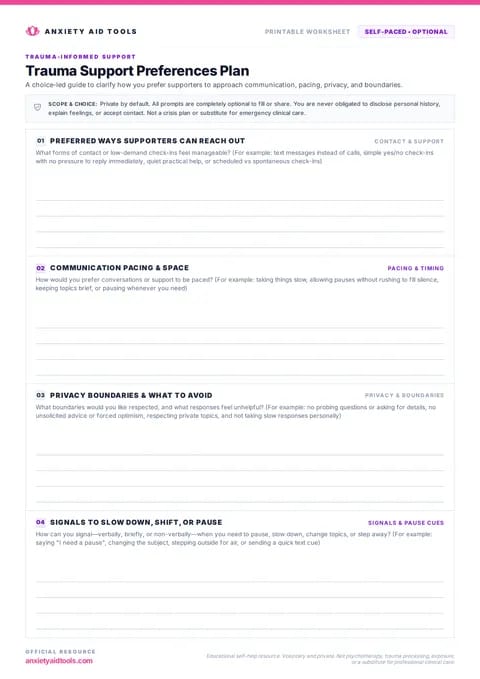
Trauma Support Preferences Plan

An optional, voluntary worksheet for clarifying trauma-informed preferences about support, communication, pacing, privacy, and boundaries.

Trauma & Triggers
Beginner
Self-Paced / Optional
Trauma Support Preferences Plan
Pro download PDF & PNG

Overview

Print for offline use during therapy or self-practice

Printable PDF and PNG formats are also available in your dashboard

When to Use

  • When you want to clarify how support may feel more manageable without describing what happened
  • Before a conversation or period of support when you want to note communication, pacing, privacy, or boundary preferences
  • When you want a low-demand reference for supporters while keeping it private or selectively shared
  • When support feels too fast, intrusive, or difficult to navigate and you want to identify a pause or communication preference

How to Use

  1. 1
    Begin only if it feels acceptable; you can skip, pause, stop, or leave any section blank.
  2. 2
    Note preferred forms of contact or low-demand check-ins, including whether you would rather have space or no contact.
  3. 3
    Describe a workable pace for communication, such as allowing pauses, keeping topics brief, or stopping when needed.
  4. 4
    Write privacy boundaries and responses to avoid without explaining personal history or trauma details.
  5. 5
    Choose a brief signal for slowing down, changing topics, or pausing, then decide whether to keep the worksheet private or share any part of it.

The Trauma Support Preferences Plan is an optional, voluntary worksheet for noting how you may prefer supporters to approach communication, pacing, privacy, boundaries, and pauses. It is a practical way to describe support preferences without needing to explain personal history.

The prompts focus on support approaches rather than the traumatic experience itself. This is not a trauma narrative, exposure exercise, or trauma-processing worksheet, and it does not require disclosure, contact, or sharing the completed page.

Use only the sections that fit. You can leave prompts blank, keep the worksheet private, or share selected preferences if you choose. Preferences can be revised as circumstances change; the worksheet does not promise a particular response or outcome from other people.
Research & References

  • Substance Abuse and Mental Health Services Administration (2014). Trauma-Informed Care in Behavioral Health Services. Treatment Improvement Protocol (TIP) Series, No. 57.
  • Sweeney, A., Filson, B., Kennedy, A., Collinson, L., & Gillard, S. (2018). A paradigm shift: Relationships in trauma-informed mental health services. BJPsych Advances, 24(5), 319-333.