AnxietyAidTools

Evidence-based mental health tools
Self-Paced

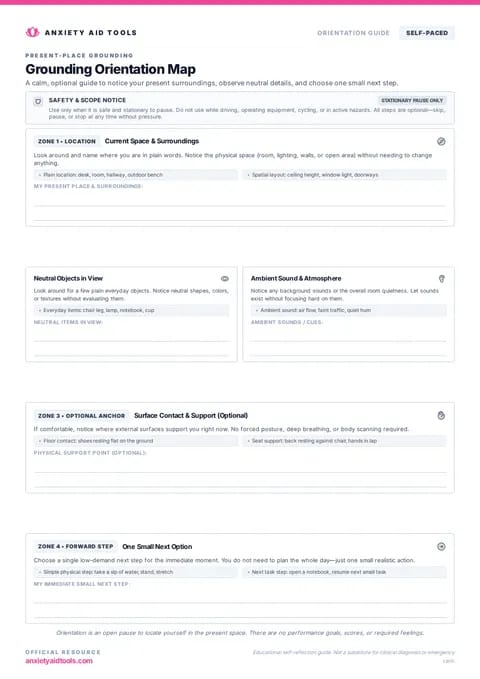
Grounding Orientation Map

A calm, optional present-place orientation guide to notice your surroundings, observe neutral details, and choose one small next step.

Grounding
Beginner
Self-Paced
Grounding Orientation Map
Pro download PDF & PNG

Overview

Print for offline use during therapy or self-practice

Printable PDF and PNG formats are also available in your dashboard

When to Use

  • When feeling spaced out, distracted, or mentally scattered in a room
  • When entering a new space and wanting a quiet, stationary pause
  • When you want an optional, non-clinical orienting guide without rigid counting exercises
  • When you want to identify one realistic next step before moving forward

How to Use

  1. 1
    Ensure you are in a safe, stationary location; do not use while driving or operating equipment.
  2. 2
    Look around and name your current physical place in plain words.
  3. 3
    Notice a few neutral details in view and hearing without needing to evaluate or alter them.
  4. 4
    Optionally notice where the chair or floor physically supports you—no forced breathing or posture required.
  5. 5
    Choose one small, low-demand next option to continue at your own pace.
  6. 6
    Remember you can skip any section, pause, or stop at any time.

The Grounding Orientation Map is a quiet, sparse reference designed to help you orient your attention to your immediate physical surroundings. Rather than demanding deep introspection, forced somatic focus, or rigid sensory countdowns, it provides a gentle, low-pressure way to notice where you are in the room.

The map guides you through four simple areas: naming your current physical location, observing neutral details in view and sound, optionally noticing external surface support, and choosing one small next step. Everything is voluntary and self-paced.

This guide is for stationary use only and must never be used while driving, cycling, operating machinery, or in unsafe environments. It does not promise instant calm or emotional control; it is simply a practical aid to re-orient whenever you feel spaced out, distracted, or ungrounded.
Research & References

  • Najavits, L. M. (2002). Seeking Safety: A Treatment Manual for PTSD and Substance Abuse. Guilford Press.
  • Substance Abuse and Mental Health Services Administration (2014). Trauma-Informed Care in Behavioral Health Services. Treatment Improvement Protocol (TIP) Series, No. 57.