Fear of Flying Cheat Sheet
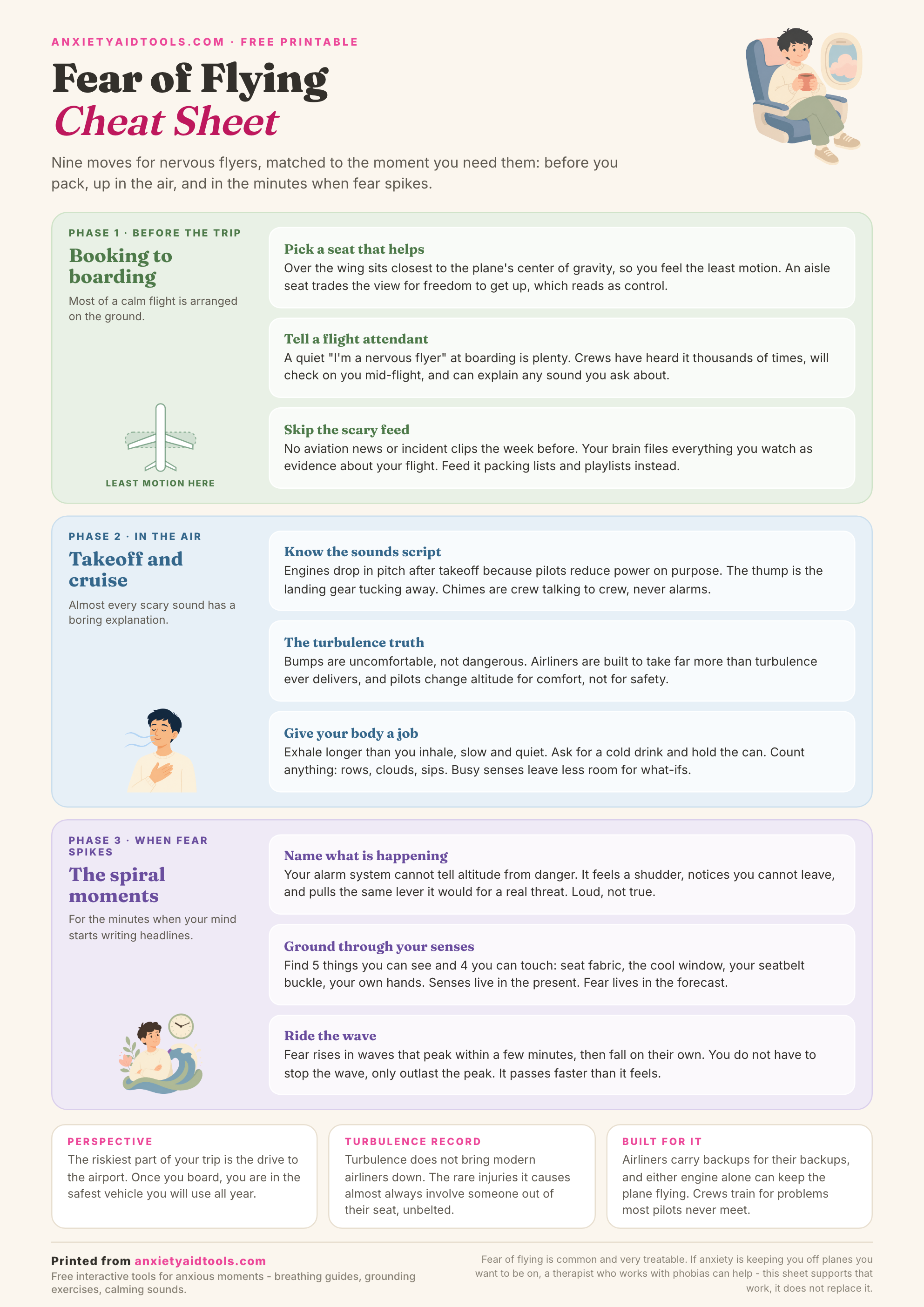
Nine moves for nervous flyers, matched to the moment you need them: before you pack, up in the air, and in the minutes when fear spikes. Includes the sounds script, the turbulence truth, and three perspective facts.
Free download · PDF & PNG
Prints on one page - A4 and US Letter versions included
These cheat sheets are free for personal use, and therapists, counselors, and teachers are welcome to print and hand them out. Please keep the footer with the source on. If you share online, a link back to this page helps other people find the free version.
What's on this cheat sheet
Booking to boarding
Pick a seat that helps (over the wing = least motion), tell a flight attendant you're a nervous flyer, and skip the scary feed the week before.
Takeoff and cruise
The sounds script (every scary sound has a boring explanation), the turbulence truth, and giving your body a job with long exhales and counting.
The spiral moments
Name what is happening, ground through your senses, and ride the wave - fear peaks pass faster than they feel.
Three perspective facts
The riskiest part of the trip is the drive to the airport, turbulence injuries are about seatbelts not crashes, and airliners carry backups for their backups.
How to use it
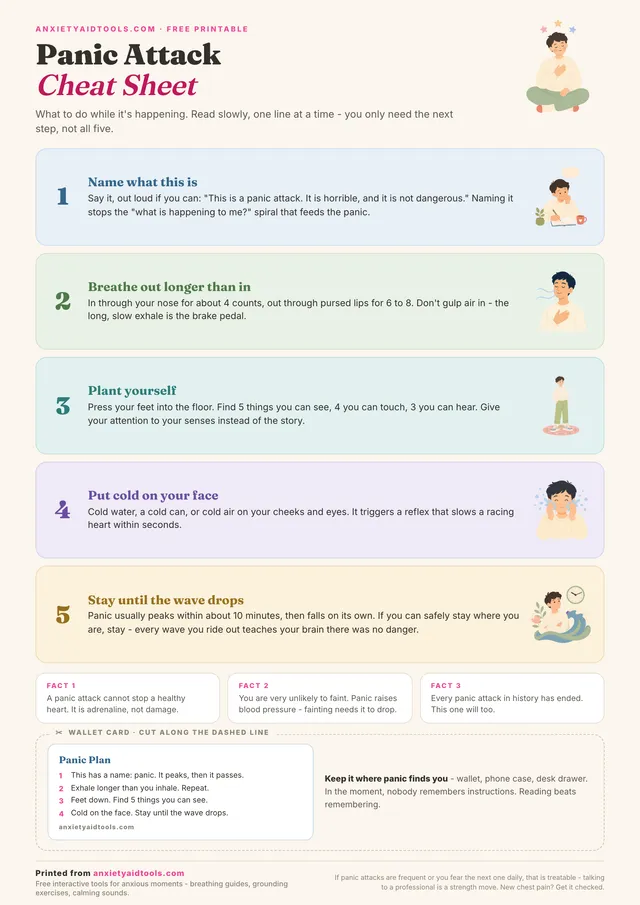
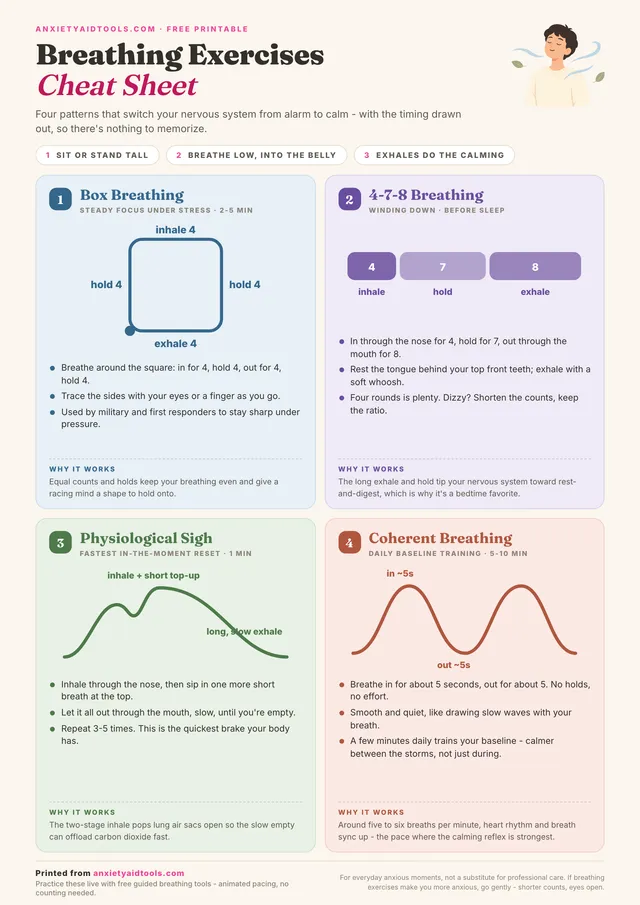
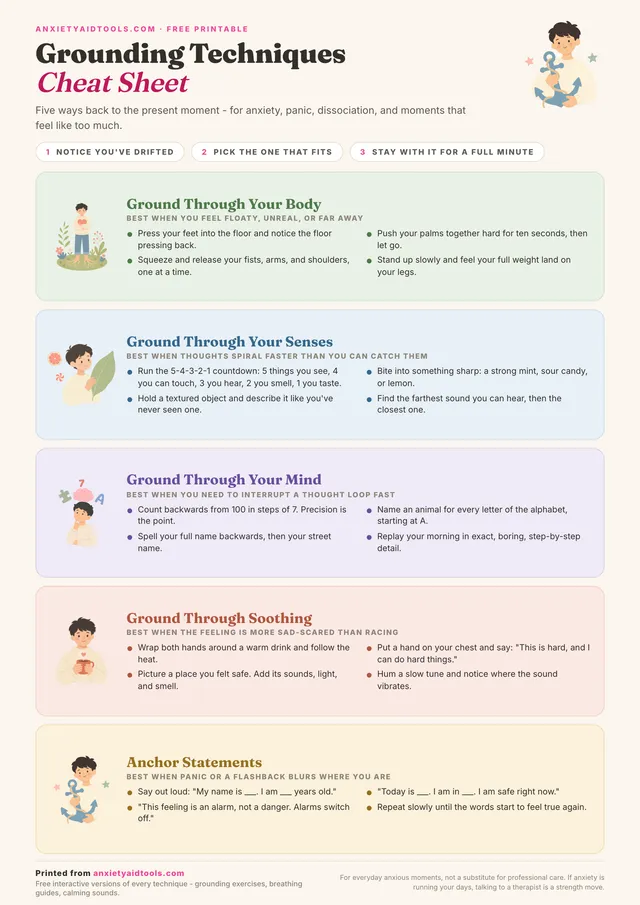
- 1
Print the sheet or save it to your phone before your trip.
- 2
Do the phase 1 moves when booking: seat choice and the no-scary-feed rule cost nothing.
- 3
In the air, work the sounds script and give your body a job.
- 4
When fear spikes, go to phase 3 and read one line at a time.
Frequently asked questions
How do I calm my fear of flying?
Work in phases. Before the trip: pick an over-wing seat, preview the route, and stop feeding your brain aviation horror content. In the air: learn what the normal sounds mean, exhale longer than you inhale, and give your senses a job. During spikes: name it as anxiety, ground through what you can see and touch, and outlast the peak - it falls on its own within minutes.
Is turbulence dangerous?
Not to the aircraft. Airliners are engineered and tested far beyond anything turbulence delivers, and pilots change altitude for comfort, not safety. The rare turbulence injuries almost always involve someone out of their seat without a seatbelt, which is why the belt sign matters and the wings do not.
What is the best seat on a plane for anxious flyers?
Over the wing sits closest to the plane's center of gravity, so you physically feel the least motion there. An aisle seat trades the view for the freedom to get up, which many anxious flyers experience as control. Window seats help people who feel calmer seeing the horizon.
Should I tell the crew I'm a nervous flyer?
Yes. A quiet "I'm a nervous flyer" at boarding is plenty. Crews have heard it thousands of times, will often check on you mid-flight, and can explain any sound or sensation you ask about. Borrowing their calm is a legitimate technique.