Grounding Techniques for Kids
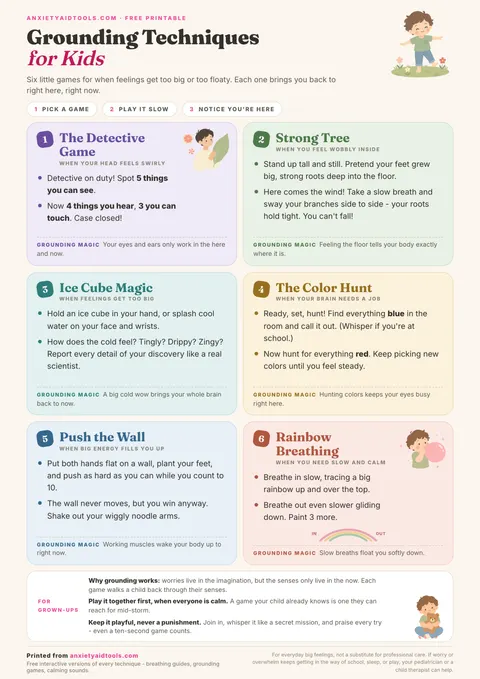
Six grounding games that turn calming down into play, from the Detective Game to Rainbow Breathing. Print it for the fridge, the classroom, or the calm-down corner so a steadying game is always within reach.
Unlock Downloads with Pro
Download high-resolution PDF (A4 & US Letter) and print-ready PNG formats for all cheat sheets directly from your dashboard.
Cheat sheets are one-page quick reference posters designed to be printed and kept where anxiety finds you. Available in A4, US Letter, and PNG formats in your Pro dashboard.
What's on this cheat sheet
The Detective Game
A kid-sized 5-4-3 senses hunt: spot 5 things you can see, 4 you can hear, and 3 you can touch, calling out each clue like a detective.
Strong Tree
A standing pose game where feet become roots and arms become branches, so a wobbly-feeling child can feel steady and planted.
Ice Cube Magic
A strong, safe cold sensation - an ice cube or cool water on the face - described out loud like a scientist reporting a discovery.
The Color Hunt
Hunt the room for everything blue, then red, then more colors until the child feels steady. Quiet enough to whisper at school.
Push the Wall
A muscle game for big, buzzy energy: push hard against a wall for a count of 10, then shake out wiggly noodle arms.
Rainbow Breathing
A slow-breathing game where one hand traces a rainbow: breathe in going up and over, breathe out gliding down, with a small rainbow diagram to follow.
For grown-ups
A short strip for parents and teachers: why grounding through the senses works, why to practice while calm, and how to keep it playful rather than punitive.
How to use it
- 1
Print the sheet and put it where big feelings tend to happen: the fridge, a classroom wall, or a calm-down corner.
- 2
Practice each game together during a calm moment so your child knows them before they are needed.
- 3
When feelings get too big, let your child pick one game and play it slowly with them.
- 4
Afterward, name what helped so your child learns which games work best for them.
Frequently asked questions
What is grounding for kids?
Grounding means using the senses - seeing, hearing, touching, moving - to bring attention back to the present moment. Worries live in a child's imagination, but the senses only work in the here and now, so noticing real sights, sounds, and textures gently interrupts the worry spiral. For kids, grounding works best as a game rather than an instruction, which is why every technique on this sheet is framed as play. Each game takes one to three minutes and needs no equipment beyond what is already in the room.
How do I ground an anxious child fast?
Start with the body, not with words: strong physical sensations reach an anxious brain faster than reasoning does. Ice Cube Magic (holding something cold or splashing cool water) and Push the Wall (pushing hard against a wall for a count of 10) both work within a minute or two. Keep your own voice slow and low, and do the game alongside your child instead of directing from the sidelines. Once their body settles a little, a quieter game like the Detective Game helps their thinking brain come back online.
What grounding games work in the classroom?
The quietest games on this sheet travel well to school: the Color Hunt can be whispered or even played silently, the Detective Game works from any seat, and Rainbow Breathing only needs one hand tracing an arc. Strong Tree works as a whole-class movement break between lessons. Teaching a game to the whole class when everyone is calm removes the stigma for the child who needs it most, and it gives every student a tool for test nerves and transitions.
What age do grounding techniques work for?
Most children can learn simple sensory grounding from around age 3 or 4, as long as the technique is concrete and playful rather than abstract. Preschoolers do best with body-based games like Strong Tree, Push the Wall, and Ice Cube Magic, while counting games like the Detective Game suit ages 5 and up. Older kids and teens often shift to the classic 5-4-3-2-1 version of the same idea. The games on this sheet stay useful across ages; only the framing needs to grow with the child.