Calm Down Corner Kit
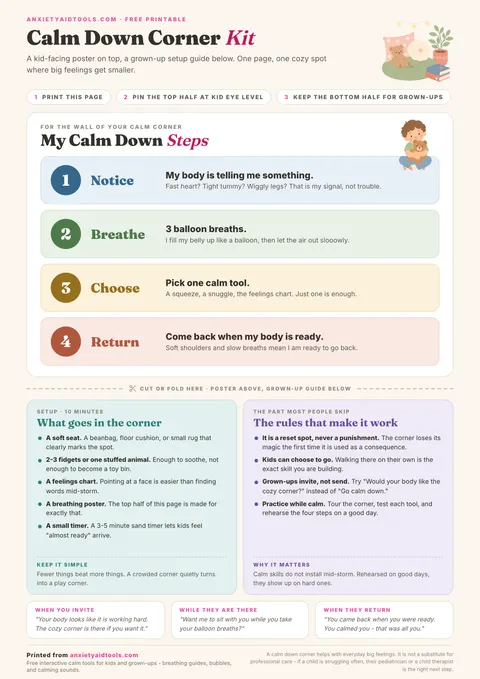
One page that sets up a whole calm down corner: a kid-facing poster with four friendly steps for the wall, and a grown-up guide underneath covering what to put in the corner and the rules that keep it working.
Unlock Downloads with Pro
Download high-resolution PDF (A4 & US Letter) and print-ready PNG formats for all cheat sheets directly from your dashboard.
Cheat sheets are one-page quick reference posters designed to be printed and kept where anxiety finds you. Available in A4, US Letter, and PNG formats in your Pro dashboard.
What's on this cheat sheet
My Calm Down Steps poster
The top half is a kid-facing poster with four big, friendly steps: Notice, Breathe, Choose, Return. Cut or fold along the dashed line and pin it at kid eye level in the corner.
Step 1 · Notice
Kids learn to read their body's signals - a fast heart, a tight tummy, wiggly legs - as information rather than trouble.
Step 2 · Breathe
Three balloon breaths: fill the belly like a balloon, then let the air out slowly. Concrete imagery kids can actually follow mid-upset.
Step 3 · Choose
Pick exactly one calm tool - a squeeze, a snuggle, or the feelings chart. One tool keeps the corner a reset spot instead of a buffet.
Step 4 · Return
Come back when the body is ready. Soft shoulders and slow breaths are the ready signals, so the child decides, not a clock.
What goes in the corner
The grown-up shopping list: a soft seat, two or three fidgets or one stuffed animal, a feelings chart, a breathing poster, and a small timer. Fewer things beat more things.
The rules that make it work
The part most setups skip: it is a reset spot and never a punishment, kids can choose to go, grown-ups invite rather than send, and everyone practices while calm.
Grown-up script lines
Three ready-to-say lines for inviting a child to the corner, sitting with them there, and celebrating the return - warm wording that keeps the corner voluntary.
How to use it
- 1
Print the page and cut or fold along the dashed line in the middle.
- 2
Pin the My Calm Down Steps poster at kid eye level inside the corner.
- 3
Stock the corner using the grown-up checklist: soft seat, a few fidgets, feelings chart, timer.
- 4
Practice the four steps together on a calm day before the corner is ever needed.
Frequently asked questions
What is a calm down corner?
A calm down corner is a small, cozy spot in a home or classroom where a child can go to settle big feelings. It usually holds a soft place to sit and a few simple regulation tools like a breathing poster, a feelings chart, and a fidget or stuffed animal. The point is not isolation; it is a predictable place where a child practices noticing their body, breathing, and returning when ready. Used well, it teaches self-regulation skills a child carries far beyond the corner.
What should I put in a calm down corner?
Start with five things: a soft seat such as a beanbag or floor cushion, two or three fidgets or one stuffed animal, a feelings chart, a breathing or steps poster pinned at kid eye level, and a small sand timer. That is genuinely enough - fewer things beat more things, because a crowded corner quietly turns into a play corner. Skip screens and anything with many pieces. The top half of this printable is designed to be the poster on the wall.
What is the difference between a calm down corner and a time out?
A time out is imposed by an adult as a consequence, and the child usually sits alone until an adult says time is up. A calm down corner is chosen regulation: the child can go on their own, an adult can warmly invite but never send, and the child returns when their own body feels ready. That difference matters because the corner only teaches self-regulation if it stays voluntary and positive. The first time it is used as a punishment, it starts working like a time out instead.
What age is a calm down corner for?
Calm down corners work well from about age two through the elementary years, with the tools adjusted to the child. Toddlers need a grown-up alongside them and very simple tools like a stuffed animal and a hug. Preschoolers and early elementary kids can follow a four-step poster like this one with practice, first together and then on their own. Older kids often prefer a more grown-up version - a quiet reading nook with headphones - but the underlying skill of noticing, breathing, and returning is the same.