Distress Tolerance Skills Cheat Sheet
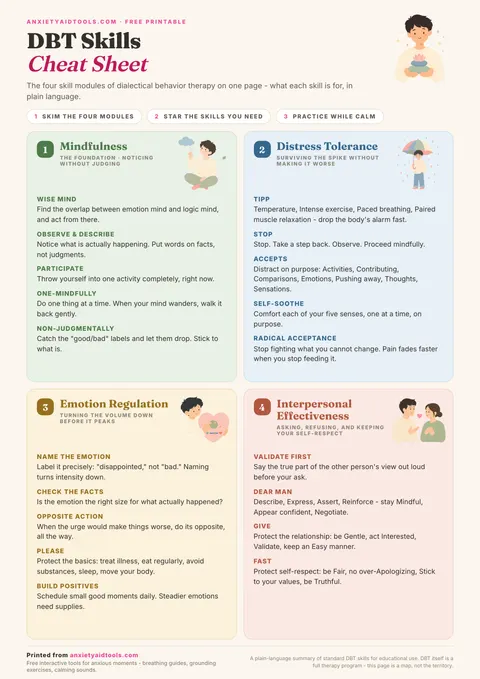
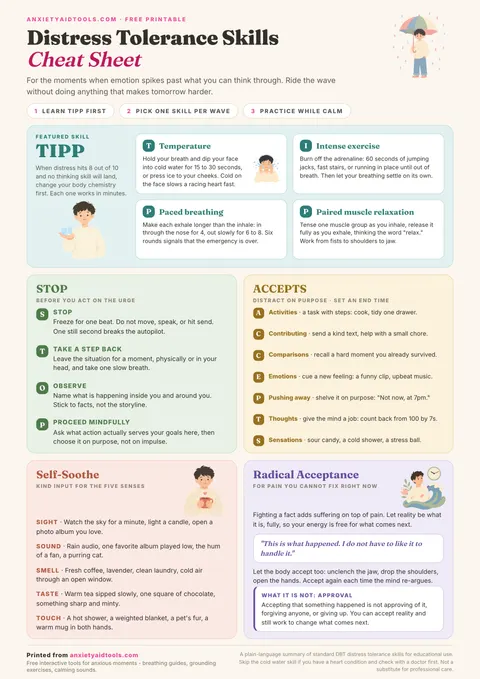
Eight DBT crisis survival skills on one printable page, with TIPP front and center. For the moments when emotion runs too hot to think your way through.
Unlock Downloads with Pro
Download high-resolution PDF (A4 & US Letter) and print-ready PNG formats for all cheat sheets directly from your dashboard.
Cheat sheets are one-page quick reference posters designed to be printed and kept where anxiety finds you. Available in A4, US Letter, and PNG formats in your Pro dashboard.
What's on this cheat sheet
TIPP (featured)
The fastest body-first reset, broken into four mini-blocks: Temperature, Intense exercise, Paced breathing, and Paired muscle relaxation, each with a concrete how-to.
STOP
A four-step brake for urge moments: Stop, Take a step back, Observe, Proceed mindfully. Built for the seconds before you say or send something you would regret.
ACCEPTS
A seven-item wise distraction menu: Activities, Contributing, Comparisons, Emotions, Pushing away, Thoughts, Sensations. Distraction as a bridge, with an end time.
Self-Soothe
Comfort through the five senses, with specific, low-effort ideas for sight, sound, smell, taste, and touch.
Radical Acceptance
What acceptance actually means for pain you cannot fix right now, a sentence to say to yourself, and a clear note on what it is not: approval, forgiveness, or giving up.
How to use it
- 1
Print the sheet and read it once while you are calm, starting with the TIPP section.
- 2
Practice one TIPP skill and one grid skill on an ordinary day so they feel familiar.
- 3
Keep the page somewhere you can reach mid-crisis: fridge door, desk drawer, journal.
- 4
When distress spikes, pick exactly one skill and follow its steps until the wave drops.
Frequently asked questions
What is distress tolerance?
Distress tolerance is a set of skills from dialectical behavior therapy (DBT) for surviving intense emotional pain without doing anything that makes the situation worse. These skills do not solve the underlying problem; they get you through the peak of the wave safely. That matters because the strongest urges, like sending the angry message or abandoning the plan, show up exactly when thinking is hardest. Once the intensity drops, you can problem-solve with a clearer head.
What does TIPP stand for?
TIPP stands for Temperature, Intense exercise, Paced breathing, and Paired muscle relaxation. Each one changes your body chemistry directly instead of trying to reason with the emotion, which is why TIPP is the go-to skill when distress is at an 8 out of 10 or higher. Cold water on the face, a minute of hard movement, long slow exhales, or tensing and releasing muscles can all lower arousal within minutes. The cheat sheet gives a concrete how-to for each of the four.
How does ice or cold water help with panic and intense distress?
Cold water on the face triggers the mammalian dive reflex, a built-in response that slows your heart rate and shifts the nervous system out of emergency mode. Holding your breath and dipping your face into cold water for 15 to 30 seconds, or pressing ice or a cold pack to your cheeks and eye area, activates it. Many people feel the intensity drop within a minute, which creates enough space to use another skill. If you have a heart condition, skip this one and check with a doctor first, since the reflex lowers heart rate quickly.
Is distress tolerance the same as avoidance?
No. Avoidance is open-ended and quietly teaches your brain that the feeling itself is dangerous, so the fear grows. Distress tolerance skills are deliberate and time-limited: you choose a skill, use it through the peak of the wave, and then come back and deal with the situation. Skills like ACCEPTS even build in an end time, and radical acceptance is the opposite of avoidance, because it means facing reality exactly as it is.