Distraction Techniques for Anxiety
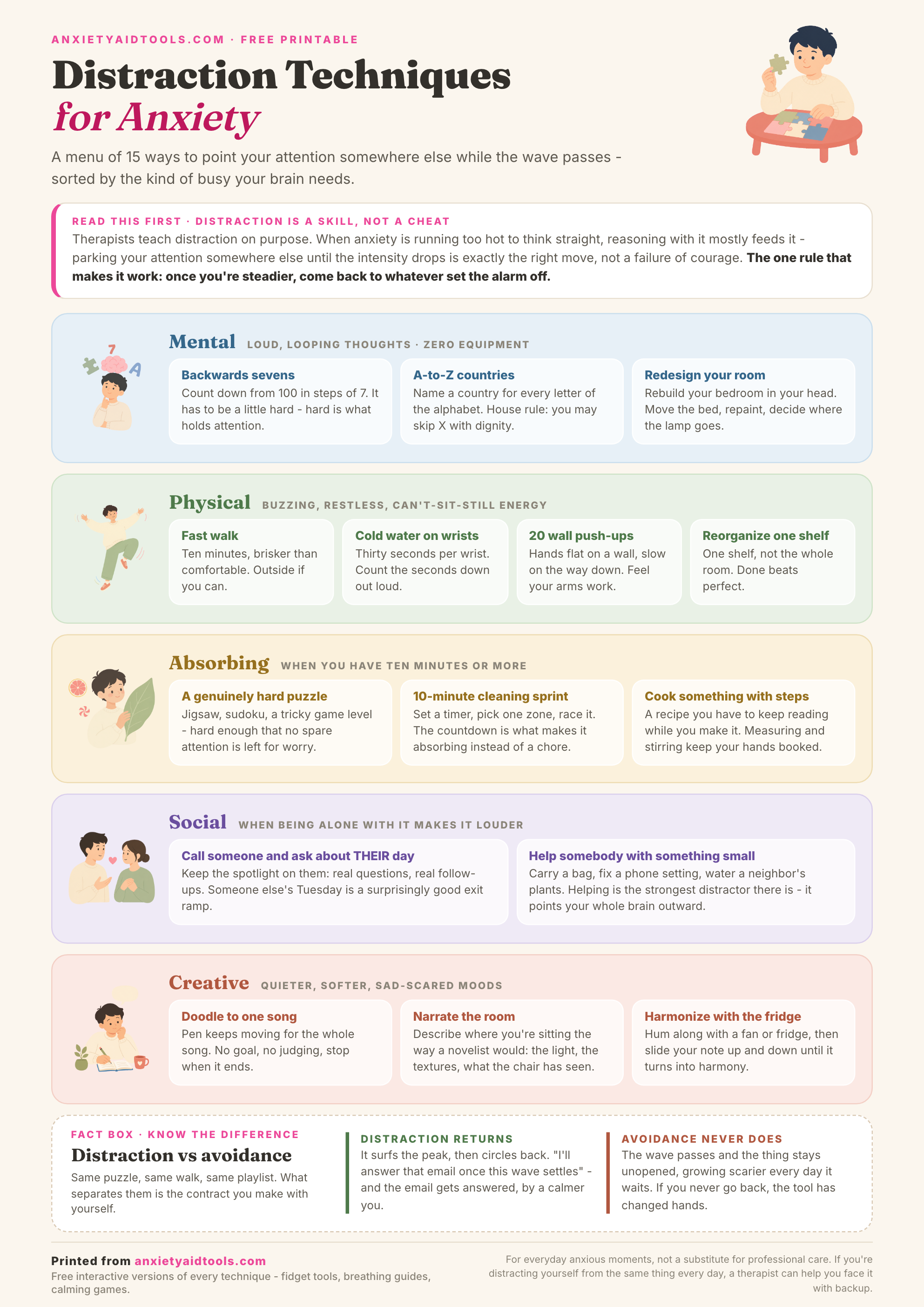
A one-page menu of 15 ways to point your attention somewhere else while an anxiety wave passes, sorted into mental, physical, absorbing, social, and creative options. It opens with a permission slip that explains why distraction is a real skill, and closes with the rule that keeps it from turning into avoidance.
Free download · PDF & PNG
Prints on one page - A4 and US Letter versions included
These cheat sheets are free for personal use, and therapists, counselors, and teachers are welcome to print and hand them out. Please keep the footer with the source on. If you share online, a link back to this page helps other people find the free version.
What's on this cheat sheet
Permission slip: distraction is a skill
A short opening note on why therapists teach distraction on purpose: when anxiety is too intense to reason with, moving your attention elsewhere until the wave drops is the right move, as long as you come back afterwards.
Mental distractions
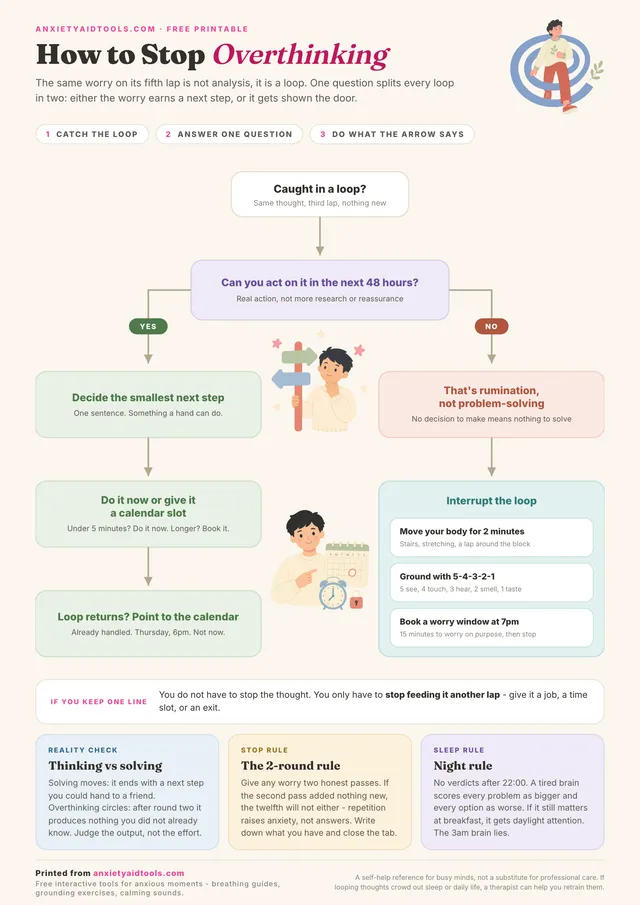
Three thinking tasks hard enough to crowd out the spiral: counting backwards from 100 by 7s, naming a country for every letter of the alphabet, and redesigning your room in your head.
Physical distractions
Four ways to spend restless energy: a fast ten-minute walk, cold water on your wrists, 20 wall push-ups, and reorganizing exactly one shelf.
Absorbing activities
Three options for when you have ten minutes or more: a genuinely hard puzzle or game, a timed cleaning sprint, and cooking a recipe with enough steps to keep your hands and eyes booked.
Social distractions
Two outward-pointing moves: calling someone and asking about their day, and helping somebody with something small, which is the strongest distractor on the sheet.
Creative distractions
Three gentle options for quieter moods: doodling for the length of one song, describing the room like a novelist, and humming to harmonize with a fan or fridge.
Fact box: distraction vs avoidance
A side-by-side comparison that makes the boundary explicit: distraction rides out the peak and then returns to the thing, while avoidance uses the same activities and never goes back.
How to use it
- 1
Print the sheet and keep it somewhere you will see it during a spike: fridge, desk, or a drawer you actually open.
- 2
When anxiety is too loud to think through, pick the category that matches your energy: buzzing means physical, looping means mental, flat means creative.
- 3
Do one technique fully and give it your whole attention until the intensity drops a notch or two.
- 4
Once you are steadier, honor the contract in the fact box: go back to whatever set the alarm off.
Frequently asked questions
Is distraction a healthy way to cope with anxiety?
Yes, when it is time-limited and you return afterwards. Therapists teach distraction deliberately because at high intensity your thinking brain is mostly offline, and trying to logic your way through a spike often feeds it instead. Turning your attention elsewhere until the wave drops is a legitimate skill, not a failure of courage. The health of the strategy lives in the return contract: distract to get through the peak, then come back to whatever triggered it once you can think straight again.
What are the best distraction techniques for anxiety?
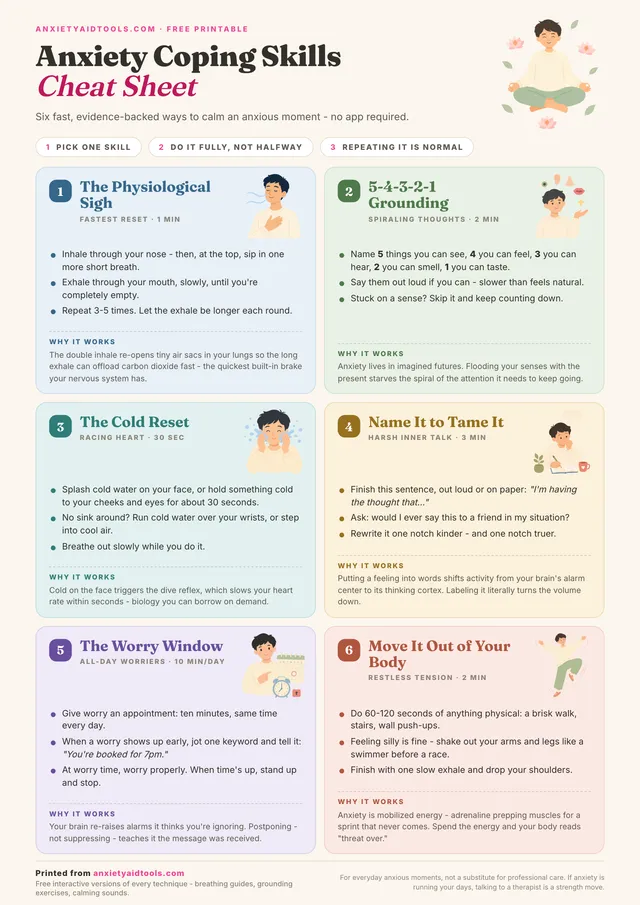
The best distractions demand your full attention, because anxiety needs spare attention to keep running. Mental tasks with built-in difficulty work well, like counting backwards by 7s or naming a country for every letter of the alphabet, and physical options like a fast walk or wall push-ups spend the adrenaline directly. Helping someone with something small is arguably the strongest of all, because it points your whole brain outward. Match the technique to your energy: buzzing bodies need movement, looping minds need a hard mental job.
What is the difference between distraction and avoidance?
The activity can be identical; the contract is what differs. Distraction says: this is too intense to handle right now, so I will do something else until the wave drops, then come back. Avoidance does the same puzzle or walk or TV show but never returns, and the avoided thing tends to grow scarier the longer it waits. A quick self-check: after using a distraction, ask whether you went back to the email, conversation, or decision. If the answer is regularly no, the tool has quietly changed jobs.
What if distraction doesn't work for my anxiety?
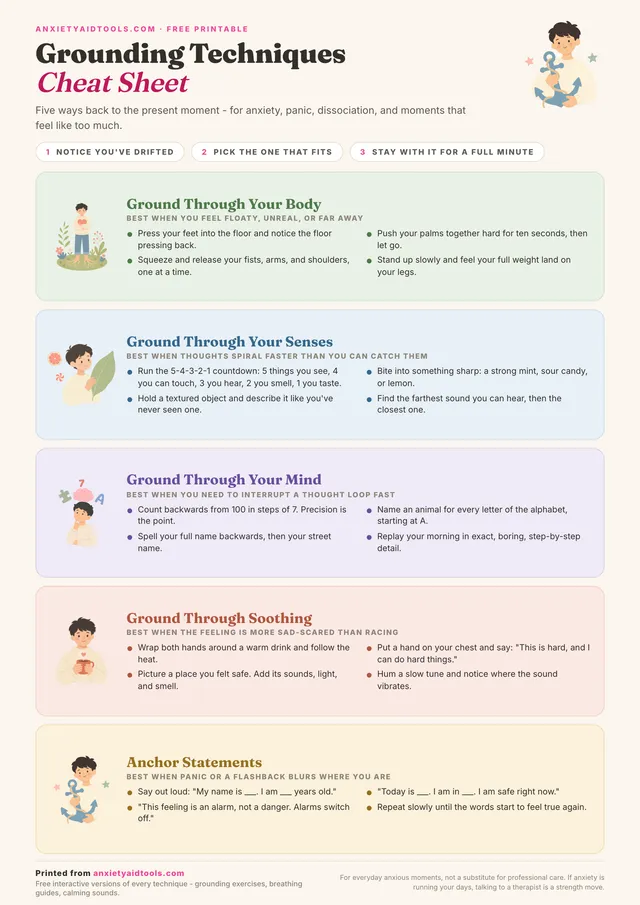
Two common reasons. First, the task may be too easy: your brain needs something genuinely demanding, so trade scrolling for backwards sevens or a puzzle that actually makes you work. Second, the intensity may simply be too high for attention tricks, in which case go body-first: cold water on your face or wrists, a burst of movement, and long slow exhales all lower arousal directly, and distraction works better once the peak has passed. If no strategy touches it and anxiety is running your days, that is a signal to bring in a therapist, not proof you are doing it wrong.