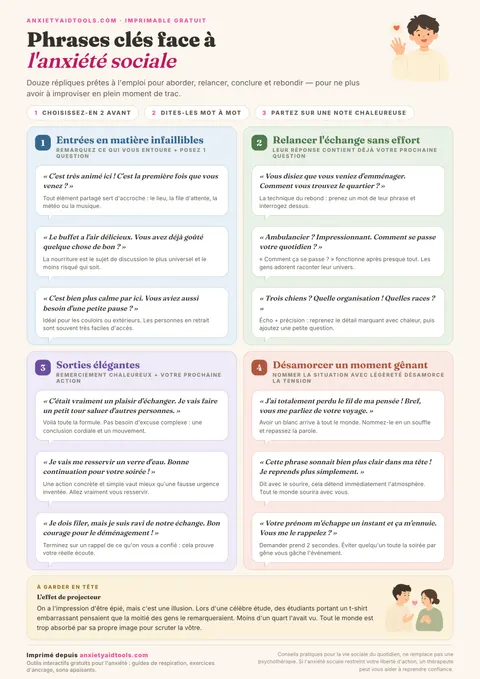
Fiche mémo : Phrases pour l'anxiété sociale
Douze répliques fluides et naturelles pour initier une conversation, relancer un échange, quitter poliment un groupe et gérer les silences sans angoisse.
Débloquez les téléchargements avec Pro
Téléchargez les formats PDF haute résolution (A4 et US Letter) et PNG prêts à imprimer pour toutes les fiches mémo directement depuis votre tableau de bord.
Les fiches mémo sont des posters de référence d'une page conçus pour être imprimés et gardés là où l'anxiété vous touche. Disponibles aux formats A4, US Letter et PNG dans votre tableau de bord Pro.
Contenu de cette fiche
Entrées en matière faciles
Prendre appui sur l'environnement commun (lieu, musique, météo) suivi d'une question ouverte simple.
La relance par la curiosité
« Comment as-tu découvert cela ? » ou « Qu'est-ce qui te plaît le plus là-dedans ? » pour laisser l'autre s'exprimer.
Sorties élégantes et chaleureuses
« C'était un plaisir d'échanger avec toi, je vais aller saluer un collègue / me chercher un verre d'eau. »
Désamorcer le silence sans panique
Un sourire posé ou une gorgée d'eau : un silence de quelques secondes est naturel et perçu comme de l'aisance.
La parade aux maladresses
« J'ai perdu le fil de mon idée ! » avec un sourire franc suffit à transformer l'hésitation en capital sympathie.
Comment l'utiliser
- 1
Choisissez 2 ou 3 phrases modèles avant de vous rendre à un événement social.
- 2
Répétez-les à voix haute chez vous pour que les mots coulent sans effort.
- 3
Rappelez-vous la règle d'or : les gens préfèrent de loin être écoutés qu'impressionnés.
- 4
Partez toujours sur une note polie et positive pour clore un échange avec aisance.
Foire aux questions
Que faire si je ne sais absolument pas quoi dire dans un groupe ?
Posez une question sur l'autre personne (« Et toi, qu'en penses-tu ? » ou « Comment tu t'es retrouvé sur ce projet ? »). Les gens adorent partager leur expérience et cela soulage toute votre pression d'improvisation.
Comment gérer la peur d'être jugé ou ridicule ?
Rappelez-vous l'illusion de transparence : les personnes autour de vous ne voient ni votre rythme cardiaque ni vos doutes. De plus, chacun est généralement bien trop occupé par sa propre image pour scruter la vôtre.
Comment quitter un groupe de discussion sans paraître impoli ?
Complimentez brièvement l'échange (« J'ai adoré notre discussion sur... »), annoncez votre prochaine action (« je vais chercher un verre / saluer l'hôte ») et souhaitez-lui une bonne soirée avec le sourire.
Puis-je utiliser ces phrases dans un cadre professionnel ?
Oui, ces formulations sont courtoises, naturelles et parfaitement adaptées aux pauses-café, séminaires, conférences et soirées de réseautage.