Fiche mémo : Récupération du burn-out
Un plan structuré en quatre phases pour sortir du burn-out : reconnaître l'épuisement, stopper les fuites d'énergie, régénérer l'organisme et renégocier son cadre de vie durablement.
Débloquez les téléchargements avec Pro
Téléchargez les formats PDF haute résolution (A4 et US Letter) et PNG prêts à imprimer pour toutes les fiches mémo directement depuis votre tableau de bord.
Les fiches mémo sont des posters de référence d'une page conçus pour être imprimés et gardés là où l'anxiété vous touche. Disponibles aux formats A4, US Letter et PNG dans votre tableau de bord Pro.
Contenu de cette fiche
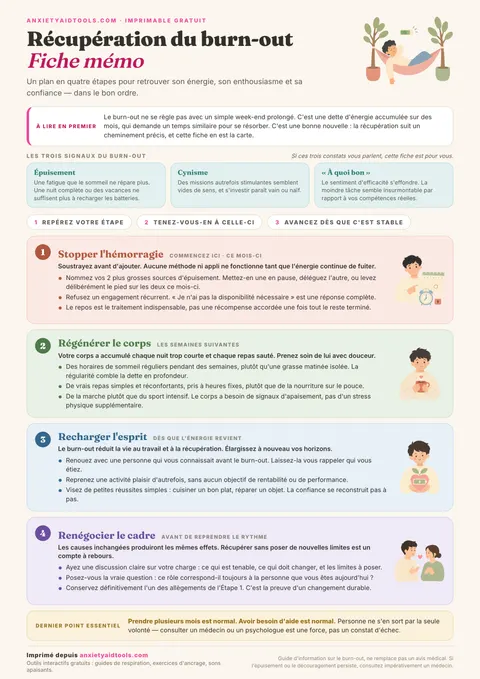
Les 3 signaux caractéristiques du burn-out
1. Épuisement profond non réparé par le sommeil, 2. Cynisme et perte de sens, 3. Effondrement du sentiment d'efficacité personnelle.
Étape 1 · Stopper l'hémorragie
Soustrayez avant d'ajouter : mettre en pause ou déléguer vos deux plus gros facteurs d'épuisement et refuser les nouveaux engagements.
Étape 2 · Régénérer le corps
Sommeil à heures fixes pendant des semaines, repas chauds et réguliers, et marche douce plutôt que sport intensif.
Étape 3 · Recharger l'esprit
Renouer avec un proche qui vous connaissait avant, reprendre une activité gratuite sans but de rentabilité et fêter de petites victoires.
Étape 4 · Renégocier le cadre
Avoir une discussion honnête sur sa charge de travail, poser de nouvelles limites protectrices et conserver un allègement définitif.
Le repos est le traitement
Le repos n'est pas une récompense à mériter une fois tout terminé, c'est le médicament indispensable pour guérir.
Prendre du temps est normal
Une dette d'énergie accumulée sur plusieurs mois demande du temps pour se résorber. Consulter un professionnel fait partie intégrante du parcours.
Comment l'utiliser
- 1
Identifiez dans quelle phase vous vous trouvez aujourd'hui (1, 2, 3 ou 4).
- 2
Concentrez 100 % de votre attention sur votre phase actuelle sans chercher à brûler les étapes.
- 3
Ne passez à l'étape suivante que lorsque la précédente est bien consolidée.
- 4
Faites-vous accompagner par un médecin traitant ou un thérapeute spécialisé.
Foire aux questions
Combien de temps faut-il pour récupérer d'un vrai burn-out ?
La récupération demande généralement entre 3 et 12 mois selon la sévérité de l'épuisement. C'est un processus biologique de reconstruction qui ne peut pas être accéléré par la simple volonté.
Pourquoi les vacances ne suffisent-elles pas à guérir du burn-out ?
Les vacances masquent temporairement la fatigue. Sans changement structurel dans la charge, les limites et la relation au travail, l'épuisement réapparaît dès les premiers jours de reprise.
Comment faire la différence entre simple fatigue et burn-out ?
La fatigue normale disparaît après un bon week-end de sommeil. Le burn-out s'accompagne d'un cynisme inhabituel, d'un sentiment d'incompétence et d'un vide intérieur persistant.
Est-il nécessaire de changer de métier après un burn-out ?
Pas toujours. Souvent, une renégociation claire des tâches, des horaires et des limites suffit. Mais la période de recul permet d'évaluer avec lucidité si l'environnement reste compatible avec vos valeurs.