Phone Call Anxiety Cheat Sheet
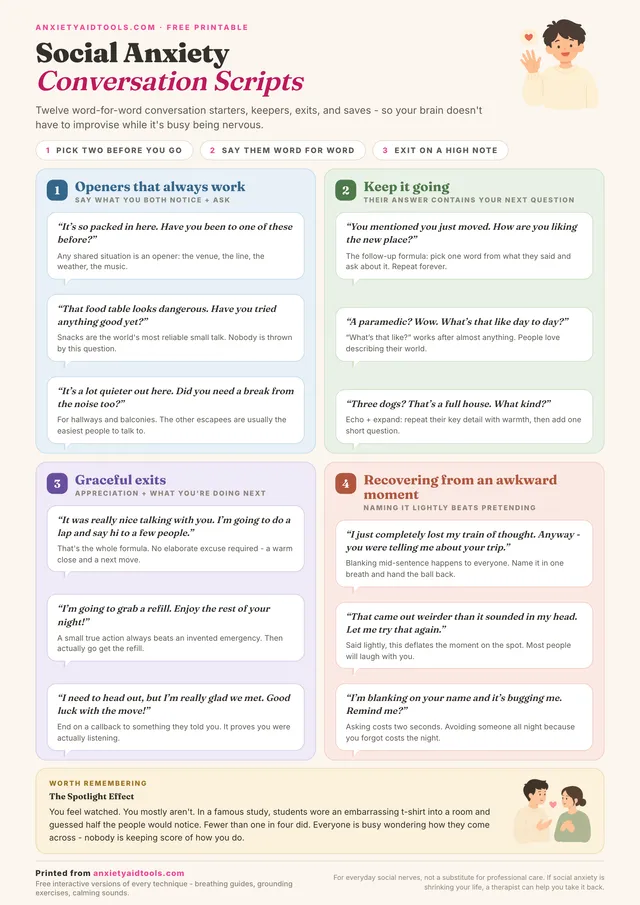
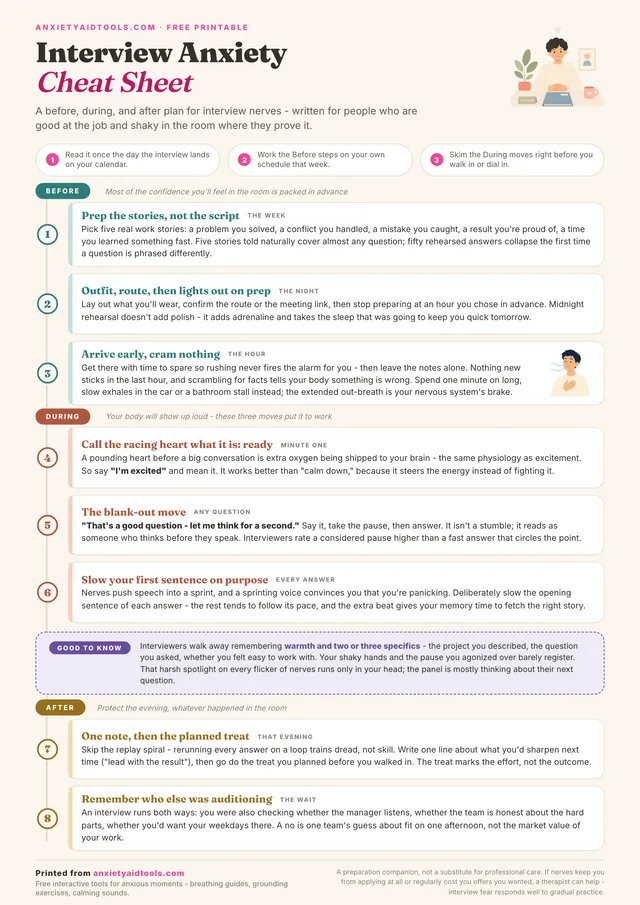
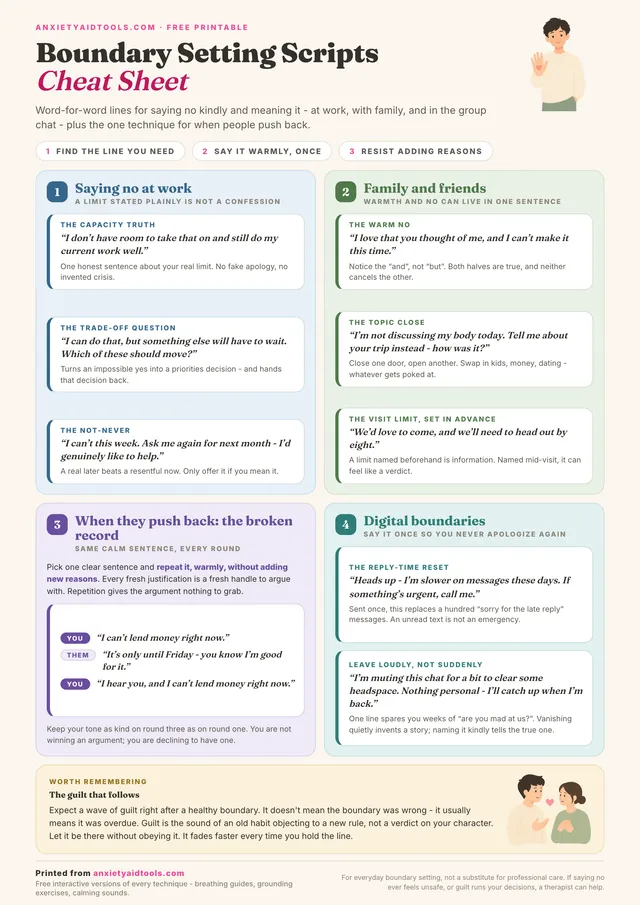
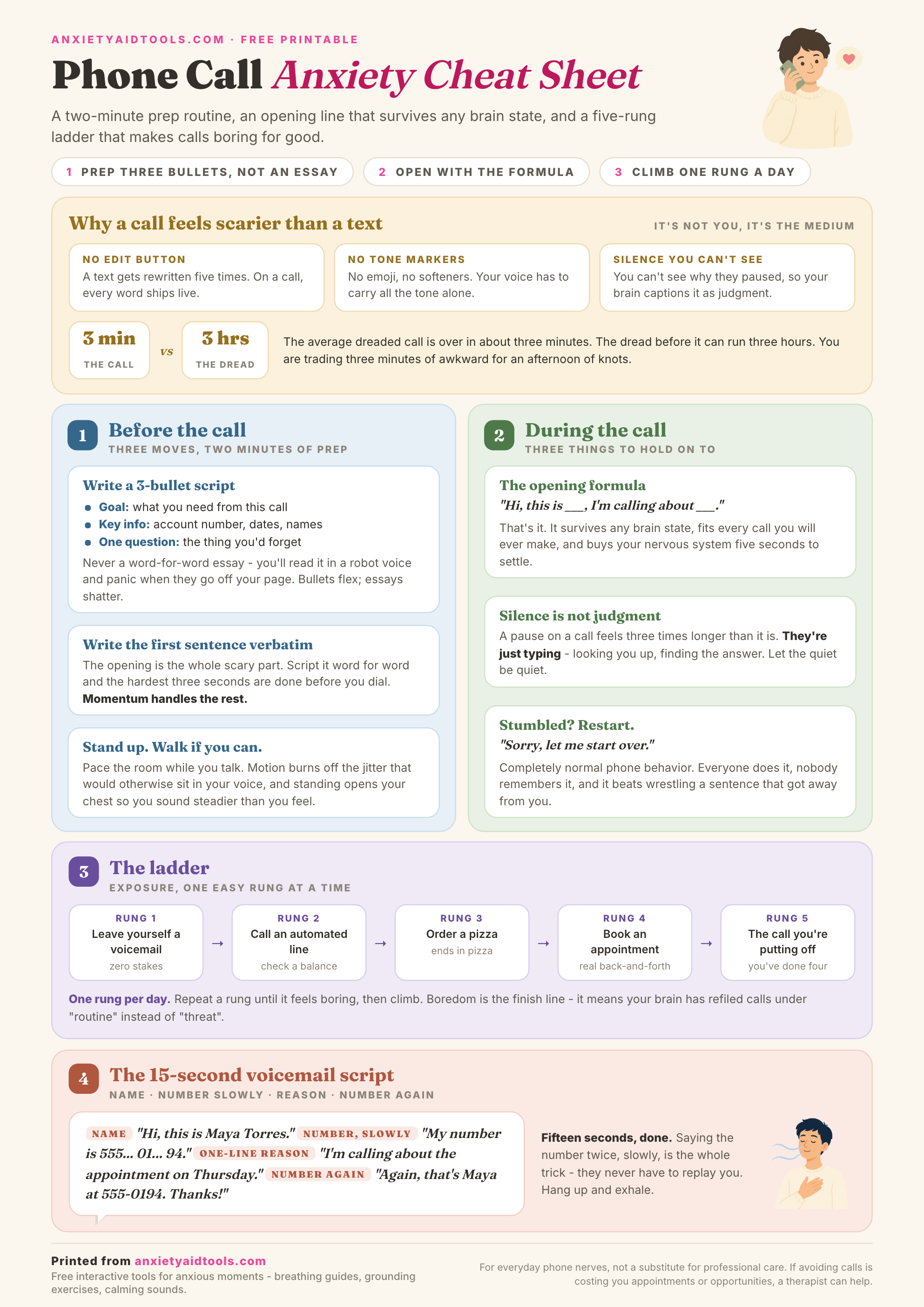
One page that walks you through the whole call: why calls feel scarier than texts, a two-minute prep routine, an opening line that survives any brain state, and a five-rung practice ladder that ends at the call you've been putting off. Print it and keep it next to your phone.
Free download · PDF & PNG
Prints on one page - A4 and US Letter versions included
These cheat sheets are free for personal use, and therapists, counselors, and teachers are welcome to print and hand them out. Please keep the footer with the source on. If you share online, a link back to this page helps other people find the free version.
What's on this cheat sheet
Why a call feels scarier than a text
Three reasons the medium itself spikes anxiety: no edit button, no tone markers, and silence you can't see the reason for. Plus the math your dread ignores: the average dreaded call lasts about three minutes, while the dread can run three hours.
Before the call
Three prep moves that take two minutes: write a 3-bullet script (goal, key info, one question), script your first sentence word for word, and stand up or pace while you dial so motion burns off the jitters.
During the call
The opening formula 'Hi, this is ___, I'm calling about ___' that survives any brain state, a reminder that pauses feel three times longer than they are, and the completely normal recovery line 'sorry, let me start over'.
The ladder
A five-rung exposure ladder from zero-stakes to the real thing: leave yourself a voicemail, call an automated line, order a pizza, book an appointment, then make the call you've been putting off. One rung per day, repeated until boring.
The 15-second voicemail script
A fill-in speech-bubble script with four labeled beats: your name, your number said slowly, a one-line reason for calling, and your number again. Fifteen seconds and you're done.
How to use it
- 1
Print the sheet and keep it near where you usually make calls.
- 2
Before a call, spend two minutes on the three prep moves: bullets, first sentence, stand up.
- 3
Open with the formula, and if you stumble, use the restart line instead of pushing through.
- 4
If calls in general scare you, climb the ladder one rung a day until each rung feels boring.
Frequently asked questions
Why do phone calls give me anxiety?
Mostly because the medium removes every safety net texting gives you. There is no edit button, so every word ships live on the first draft. There are no emoji or tone markers, so your voice has to carry all the warmth by itself. And when the other person goes quiet, you can't see why, so your brain fills the gap with judgment when the real answer is usually that they're typing. None of that means something is wrong with you; it means calls are objectively a harder channel, and skills like scripting your opening make them manageable fast.
How do I get over my fear of making phone calls?
Gradual practice beats willpower, and the cheat sheet's ladder gives you the exact rungs: leave yourself a voicemail, call an automated line to check a balance, order a pizza, book an appointment, then make the call you've been putting off. Do one rung per day and repeat a rung until it feels boring before you climb. Boredom is the goal, because it means your brain has refiled phone calls under routine instead of threat. Most people are surprised how quickly the top rung shrinks once the bottom four are done.
What do I say when I call someone?
Prep a 3-bullet script, never a word-for-word essay: your goal for the call, the key info you might need (account numbers, dates, names), and the one question you'd otherwise forget to ask. Then open with the formula 'Hi, this is ___, I'm calling about ___', which works on every call you will ever make and survives any brain state. The only line worth scripting verbatim is your first sentence, because the opening is the genuinely hard part; once it's out, momentum carries the rest.
Why do I rehearse phone calls for hours?
That's anticipatory anxiety, and it is almost always bigger than the event it's guarding against: the average dreaded call is over in about three minutes, while the dreading can run three hours. Your brain treats the upcoming call as an open threat and keeps rehearsing to feel prepared, but rehearsal past a few minutes stops adding safety and starts feeding the dread. Cap your prep at the three bullets and one scripted first sentence, then set a time to dial. Making the call is the only thing that actually closes the loop.