Progressive Muscle Relaxation Script
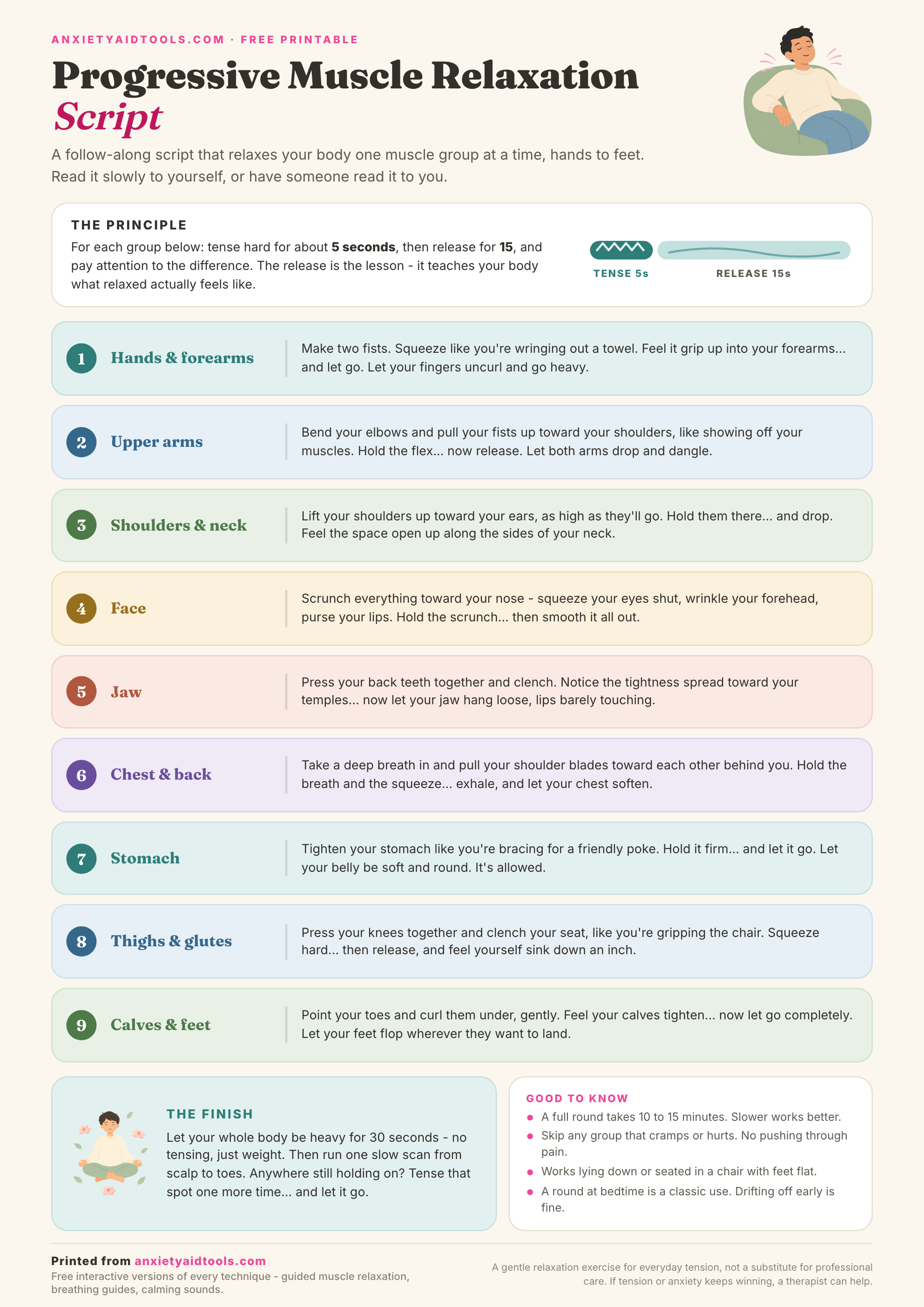
A follow-along PMR script through nine muscle groups, written as spoken instructions: tense hard for about five seconds, release for fifteen, and feel the difference. The release teaches your body what relaxed actually feels like.
Free download · PDF & PNG
Prints on one page - A4 and US Letter versions included
These cheat sheets are free for personal use, and therapists, counselors, and teachers are welcome to print and hand them out. Please keep the footer with the source on. If you share online, a link back to this page helps other people find the free version.
What's on this cheat sheet
The principle
Tense each muscle group hard for about 5 seconds, release for 15, and study the contrast - that contrast is the skill.
Nine muscle groups
Hands and forearms, upper arms, shoulders and neck, face, jaw, chest and back, stomach, thighs and glutes, calves and feet, each with a short spoken-style instruction.
The finish
Thirty seconds of whole-body heaviness and one slow scan for leftover tension.
Practical notes
10-15 minutes total, works seated or lying down, skip any group that cramps or hurts.
How to use it
- 1
Print the script and keep it beside your bed or chair.
- 2
Work top to bottom: squeeze each group hard for about 5 seconds, then release for 15.
- 3
Put your attention on the release - the warm, heavy feeling is the point.
- 4
Practice daily for a week and your body starts finding the relaxed state on its own.
Frequently asked questions
How do you do progressive muscle relaxation?
You move through the body's muscle groups one at a time, tensing each hard (but never to pain) for about five seconds, then releasing for about fifteen and noticing the contrast. A full pass through nine groups takes 10-15 minutes seated or lying down.
Why tense muscles in order to relax them?
Because of the contrast effect. Most people carry so much baseline tension that "just relax" means nothing - there is no reference point. Deliberately tightening and then releasing shows your nervous system the difference between clenched and loose, and the release swings the muscle looser than it started.
Is PMR good for sleep?
It is one of the better-evidenced wind-down techniques. Run the script in bed, top to bottom, letting each release sink you further into the mattress. Many people do not reach their feet before drifting off, which is the desired failure mode.
How long does PMR take to work?
The first session usually produces noticeable physical loosening within the 10-15 minutes. The bigger payoff arrives after one or two weeks of daily practice, when your body learns to drop into the released state on cue, without needing the full sequence.