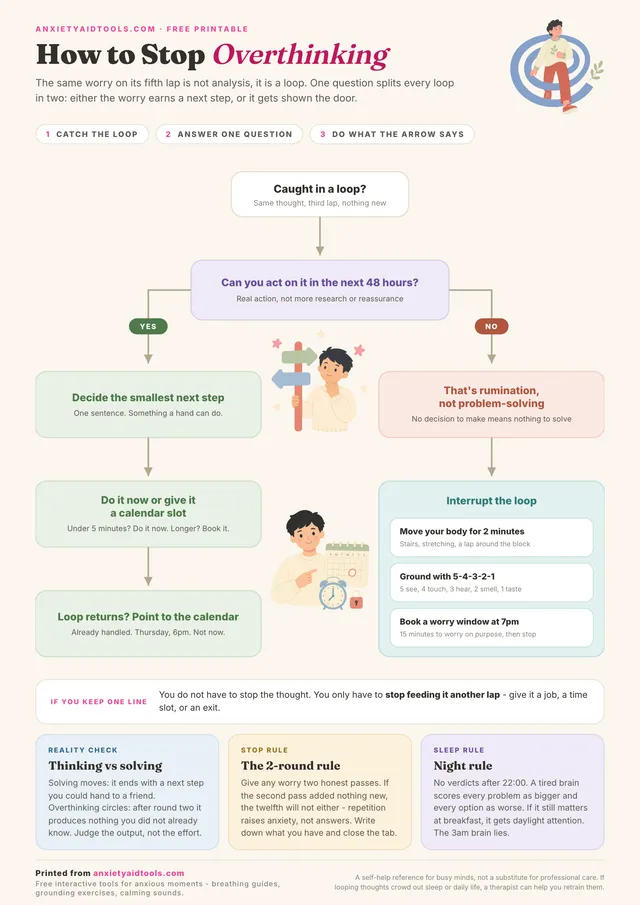
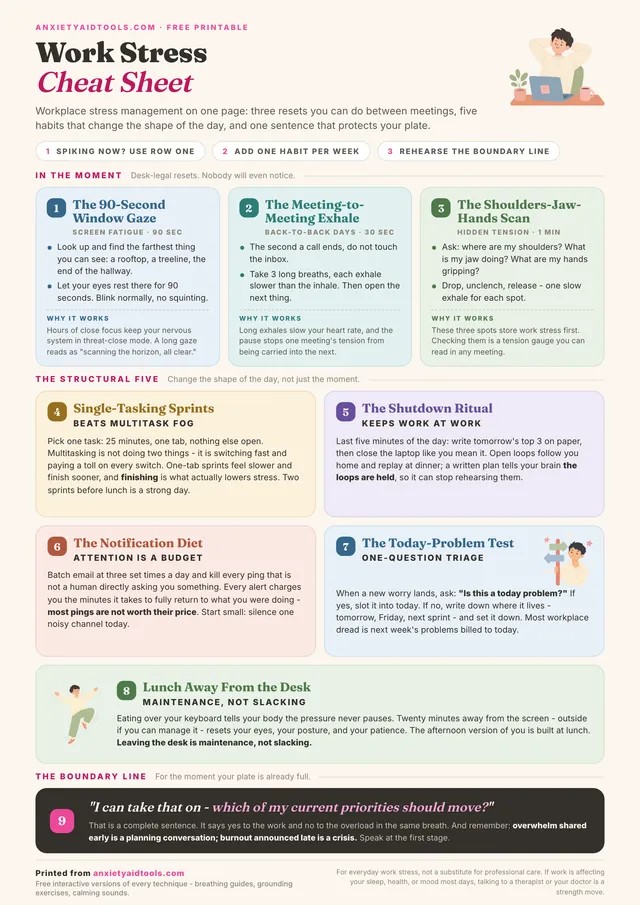
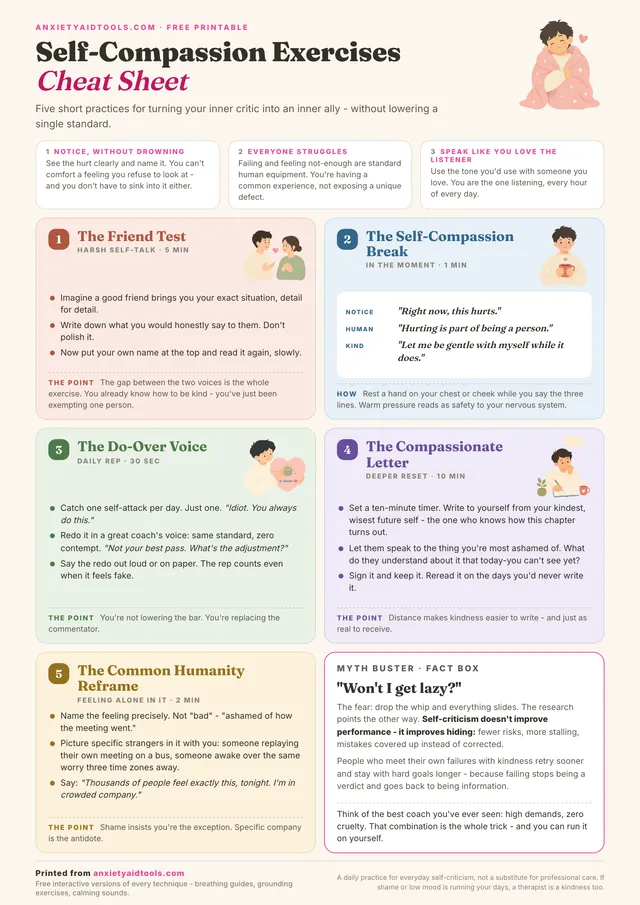
ADHD Overwhelm Cheat Sheet
Seven strategies for the moments when everything feels like too much and nothing will start, built around how ADHD brains actually work. No willpower lectures: just the unfreeze move, smaller doorways, body doubling, and other ways to work with your wiring instead of against it.
Free download · PDF & PNG
Prints on one page - A4 and US Letter versions included
These cheat sheets are free for personal use, and therapists, counselors, and teachers are welcome to print and hand them out. Please keep the footer with the source on. If you share online, a link back to this page helps other people find the free version.
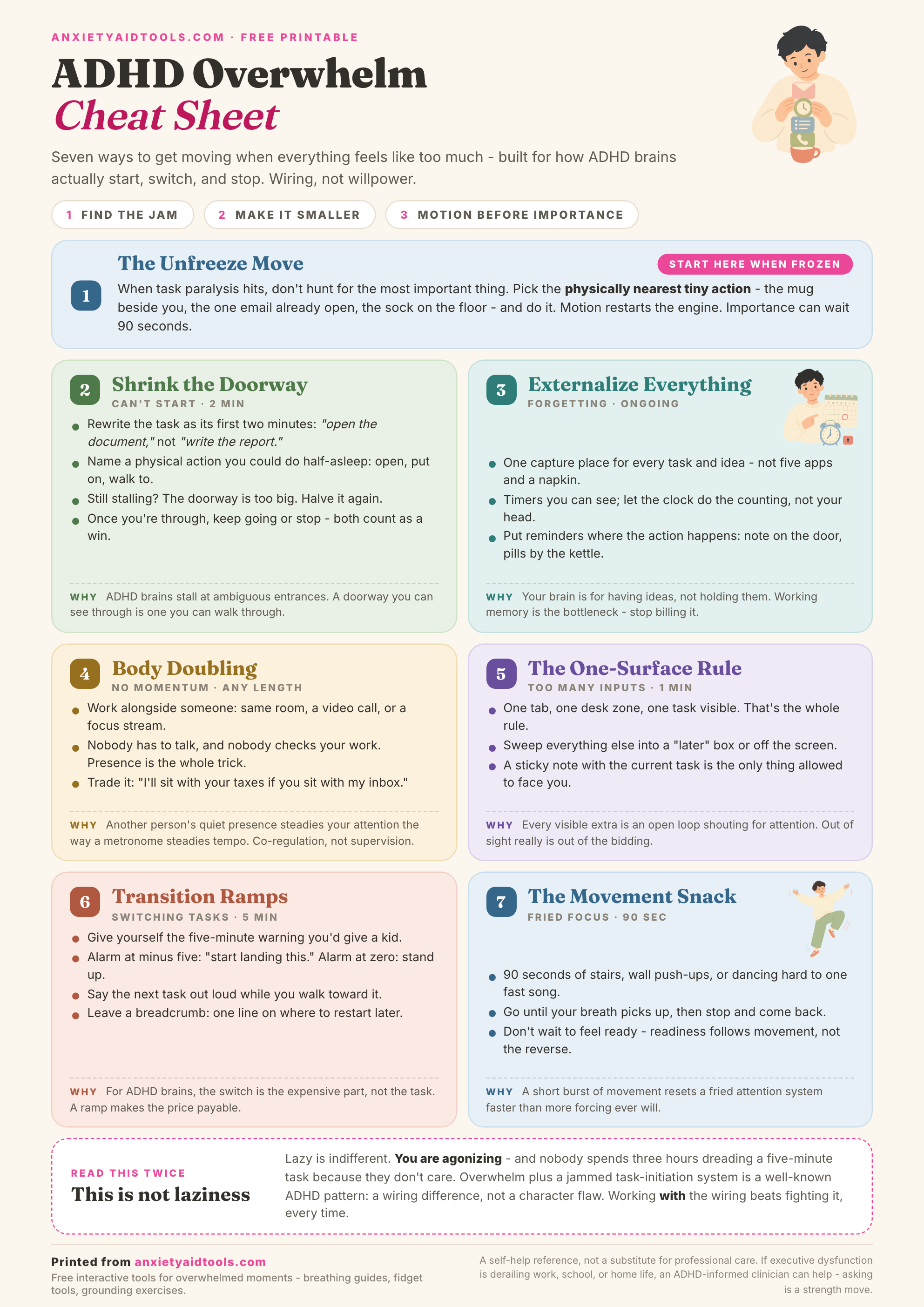
What's on this cheat sheet
The Unfreeze Move
When task paralysis hits, pick the physically nearest tiny action instead of the most important one. Motion restarts the engine; importance can wait 90 seconds.
Shrink the Doorway
Rewrite the task as its first two minutes: open the document, not write the report. ADHD brains stall at ambiguous entrances, so make the entrance concrete and small.
Externalize Everything
Your brain is for having ideas, not holding them. One capture place, visible timers, and reminders placed where the action happens take the load off working memory.
Body Doubling
Work alongside someone in person or on video. Nobody has to talk and nobody checks your work; another person's quiet presence steadies your attention on its own.
The One-Surface Rule
One tab, one desk zone, one task visible. Every visible extra is an open loop shouting for attention, so sweep the rest out of sight before you start.
Transition Ramps
Give yourself the five-minute warning you would give a kid: alarms before switches, not just at deadlines, plus a one-line breadcrumb so re-entry is cheap.
The Movement Snack
90 seconds of stairs, wall push-ups, or one fast song danced hard resets a fried attention system faster than more forcing ever will.
This is not laziness
A fact strip worth reading twice: lazy is indifferent, and nobody spends three hours agonizing over a five-minute task because they do not care. It is wiring, not character.
How to use it
- 1
Print the sheet and keep it where overwhelm usually finds you: desk, fridge, or inside your laptop lid.
- 2
When you are stuck, start at the top band and do the unfreeze move before anything else.
- 3
Then match one numbered strategy to the specific jam: starting, remembering, switching, or fried focus.
- 4
Reread the fact strip at the bottom whenever the self-criticism starts up. That part is not optional.
Frequently asked questions
Why do I freeze when I have too much to do?
ADHD task paralysis is a traffic jam at the brain's starting gate, not a motivation problem. When every task feels equally urgent, the system that picks and launches an action gets flooded and simply stalls, which is why you can want desperately to move and still sit frozen. The fix is counterintuitive: stop trying to choose the right task and just create motion with the nearest tiny action. Once the engine is running, choosing gets dramatically easier.
How do I start a task when starting is the hard part?
Shrink the doorway: rewrite the task as its first two physical minutes, like open the document or put on one shoe. ADHD brains stall at ambiguous entrances, so a vague task like write the report has no visible first move and stays untouched no matter how much it matters. If the two-minute version still will not start, it is still too big, so halve it again. Getting through the doorway counts as a win whether you keep going or not.
What is body doubling and why does it work?
Body doubling means working alongside another person, in the same room or on a video call, while you each do your own thing. Nobody talks, nobody supervises, and nobody checks your work; the other person's quiet presence is the entire mechanism. That presence helps regulate an ADHD nervous system the way a metronome steadies tempo, making it easier to start and stay with a task. Many people find a silent video call or a focus-room stream works just as well as sharing a desk.
Is ADHD overwhelm the same as laziness?
No, and the difference is easy to spot: laziness is indifference, while ADHD overwhelm is agonizing. A lazy person does not spend three hours dreading a five-minute task, because dread only happens when you care and cannot start. Overwhelm combined with jammed task initiation is a well-documented ADHD pattern rooted in how the brain launches actions, which is a wiring difference rather than a character flaw. Strategies that work with that wiring, like the ones on this sheet, consistently beat trying harder.