AnxietyAidTools

Evidence-based mental health tools
15 min

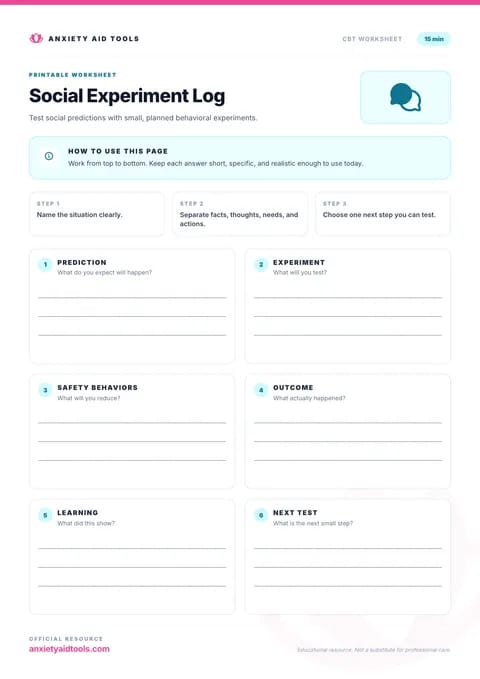
Social Experiment Log

Test social predictions with small, planned behavioral experiments.

Anxiety & Worry
Intermediate
15 min
Social Experiment Log

When to Use

  • Before a manageable social challenge
  • When predictions feel certain but untested
  • During exposure or CBT homework
  • After avoiding a situation you want to revisit

How to Use

  1. 1
    Write one specific prediction before the situation.
  2. 2
    Design a small experiment that can test the prediction.
  3. 3
    Choose one safety behavior to reduce during the test.
  4. 4
    Record what happened as objectively as possible.
  5. 5
    Compare the outcome with the original prediction.
  6. 6
    Plan the next experiment at a similar or slightly higher level.

Download PDF and PNG with Pro

Preview this worksheet for free. Pro unlocks downloadable PDF and PNG versions, fillable worksheets, and saved progress.

Unlock Pro

The Social Experiment Log helps test anxious predictions in real situations. Social anxiety often creates strong forecasts about embarrassment, rejection, or being judged. Behavioral experiments collect evidence instead of relying on prediction alone.

This worksheet asks you to name one prediction, plan a small experiment, reduce one safety behavior, and compare the outcome with what you expected. The focus is learning, not performing perfectly.

Use it for manageable social steps such as asking a question, making brief eye contact, joining a conversation, or letting a small silence happen. Repeated experiments build a more accurate picture of social risk.
Research & References

  • Clark, D. M., & Wells, A. (1995). A cognitive model of social phobia. Social Phobia: Diagnosis, Assessment, and Treatment.
  • Bennett-Levy, J., Butler, G., Fennell, M., Hackmann, A., Mueller, M., & Westbrook, D. (2004). Oxford Guide to Behavioural Experiments in Cognitive Therapy. Oxford University Press.