Public Speaking Anxiety Cheat Sheet
The nerves-proof speaking kit: how to rehearse so your mouth knows the words, what to do in the sixty seconds before you're on, recovery moves for lost places and shaky voices, and the research fact that audiences see a fraction of what you feel.
Unlock Downloads with Pro
Download high-resolution PDF (A4 & US Letter) and print-ready PNG formats for all cheat sheets directly from your dashboard.
Cheat sheets are one-page quick reference posters designed to be printed and kept where anxiety finds you. Available in A4, US Letter, and PNG formats in your Pro dashboard.
What's on this cheat sheet
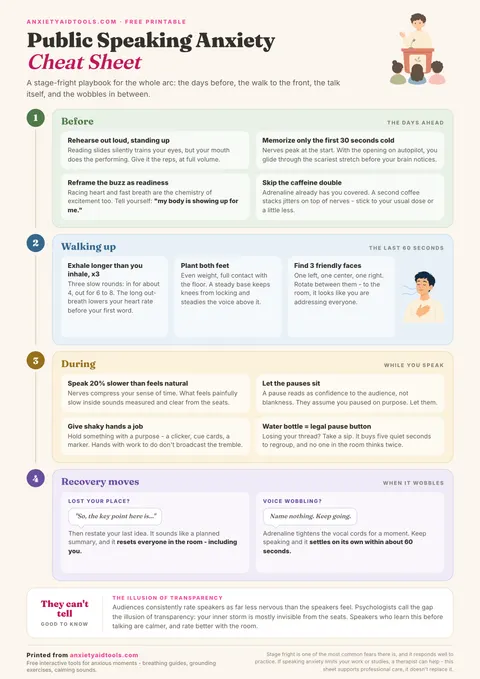
Before
Rehearse out loud standing up, memorize only the first 30 seconds cold, reframe arousal as readiness, and skip the double espresso.
Walking up
Three long exhales, both feet planted, and three friendly faces picked out to rotate between.
During
Speak 20% slower than feels natural, treat pauses as confidence, give shaky hands something to hold with a job.
Recovery moves
"So, the key point here is..." resets a lost place for everyone including you; a wobbly voice settles within a minute if you keep going.
The transparency fact
Audiences systematically rate speakers as far less nervous than speakers feel - your internal weather barely broadcasts.
How to use it
- 1
Print the sheet and use the Before column while preparing your talk.
- 2
Rehearse standing up and out loud - the mouth needs repetitions, not the eyes.
- 3
Read the walking-up ritual right before you're introduced.
- 4
If something goes sideways mid-talk, use the recovery lines instead of apologizing.
Frequently asked questions
How do I stop being nervous about public speaking?
You don't aim for zero nerves - you aim for nerves that work for you. Rehearse out loud standing up, memorize the first 30 seconds cold so autopilot carries you through the scariest part, reframe the adrenaline as readiness, and slow your opening sentence deliberately. Nerves fade once you're rolling.
Why does my voice shake when I present?
Adrenaline tightens the muscles around your vocal cords and speeds your breathing, which produces the wobble. The counterintuitive fix is to keep speaking: the shake almost always settles within the first minute as your body burns through the initial surge. Naming it or apologizing draws attention to something most listeners hadn't noticed.
Do audiences notice how nervous I am?
Far less than you think. The illusion of transparency is the robust finding that speakers massively overestimate how visible their internal state is. Audiences see a person talking; you feel a heart pounding. The two broadcasts are very different channels.
Does picturing the audience in their underwear work?
No - it adds a weird mental task on top of an already busy brain. What actually works: three friendly faces to rotate between, a 20% slower pace, planned pauses, and giving your hands a job. Attention pointed outward at your message beats attention pointed inward at your body.