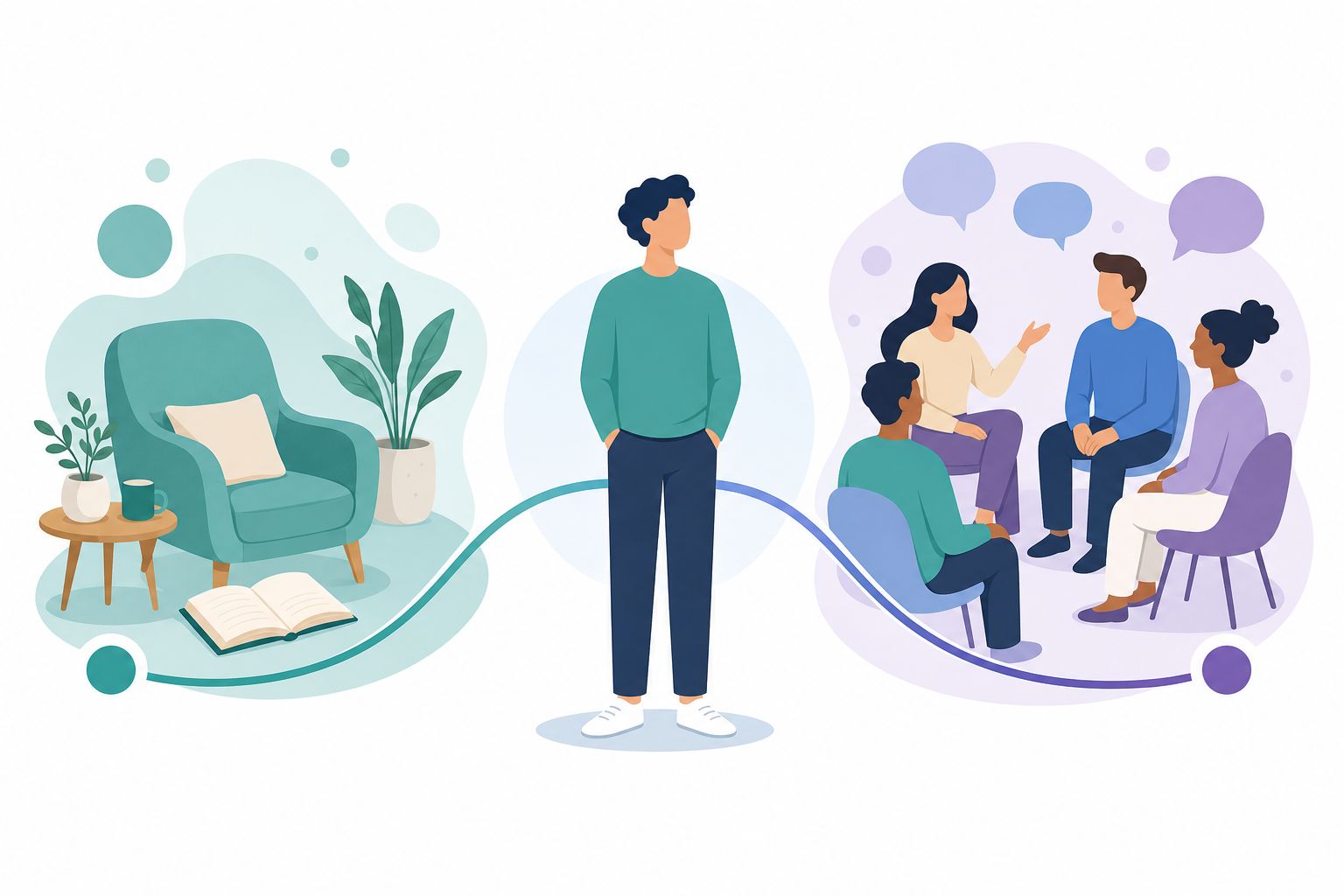
Introvert or Extrovert Test: What Feels Like You?
Do you recharge alone or around people? Take this introvert or extrovert test to explore the social energy that feels most natural to you.
Who Is This Test For?
This self-test is for adults who want a brief, research-based reflection on social energy using the Mini-IPIP Extraversion items.
- People curious about where they fall on an introversion-extroversion continuum
- Anyone who wants non-diagnostic language for understanding social energy
- People comparing how they feel in groups, one-on-one settings, and quiet time
- Anyone who wants a brief Big Five-based reflection without fixed type labels
Rate how accurately each statement describes you in general. There are no good or bad answers; choose the option that best fits your usual pattern.
Am the life of the party.
Talk to a lot of different people at parties.
Don’t talk a lot.
Keep in the background.
Sympathize with others’ feelings.
Feel others’ emotions.
Am not really interested in others.
Am not interested in other people’s problems.
Get chores done right away.
Like order.
Often forget to put things back in their proper place.
Make a mess of things.
Have frequent mood swings.
Get upset easily.
Am relaxed most of the time.
Seldom feel blue.
Have a vivid imagination.
Have difficulty understanding abstract ideas.
Am not interested in abstract ideas.
Do not have a good imagination.
Good To Know

Plan Around Energy, Not Labels
Instead of asking whether you are an introvert or extrovert, notice what restores you after different situations. Use that pattern to plan meetings, quiet time, and recovery space.

Use Context-Specific Language
Personality scores are broad. You may be outgoing with close friends and quiet in unfamiliar groups, or talkative at work and reserved afterward. Specific context is more useful than a single label.
Balance Stretch and Recovery
If you want to practice a less familiar social style, pair it with recovery. A reserved person might plan one intentional conversation; an outgoing person might practice pausing and listening.
Understanding the Mini-IPIP Extraversion Score
T he Mini-IPIP is a brief public-domain measure of the Big Five personality factors. This page includes all 20 Mini-IPIP items for quality, but the main result shown here is the 4-item Extraversion subscale because the page focuses on introversion and extroversion.
Mini-IPIP item responses are scored from 1 to 5. Positively keyed items keep their response value, while negatively keyed items are reversed. The Extraversion subscale therefore ranges from 4 to 20.
The reserved, balanced, and outgoing bands used here are practical feedback ranges, not validated clinical cutoffs. A score near the middle should not be treated as better or worse than a score near either end.
A published reference average around 13.7 is sometimes cited for context, so this page uses 14 as a rough reference point only. It is not an official norm and should not be used to diagnose, rank, or type people.
Frequently Asked Questions
Is this an introvert or extrovert diagnosis?
No. The result describes your current Extraversion subscale score on a continuum. It should not be treated as a diagnosis, a fixed personality type, or a complete description of who you are.
Why are there 20 questions if the result focuses on Extraversion?
The Mini-IPIP is a 20-item Big Five questionnaire with four items for each trait. Including the full item set keeps the instrument intact, while this page’s displayed score focuses on the four Extraversion items.
How is the score calculated?
Each answer maps to 1 through 5. The two positively keyed Extraversion items use that value directly, and the two negatively keyed Extraversion items are reversed before being added. The final displayed score ranges from 4 to 20.
Are the score bands validated cutoffs?
No. The bands are safe user-experience ranges for reflection: 4-8 reserved, 9-15 balanced, and 16-20 outgoing. They are not official Mini-IPIP diagnostic or normative categories.
Can I use the Mini-IPIP items freely?
IPIP items and scales are public domain according to the official IPIP permission statement, with no request needed for use, including commercial use. The sources section links to the permission statement and official Mini-IPIP key.
More Tests

Sources & References
This self-test is for education and reflection only. It is not a mental health diagnosis, clinical assessment, or fixed personality type. Scores can be influenced by current stress, culture, role demands, health, and recent experiences.