Racing Thoughts at Night Cheat Sheet
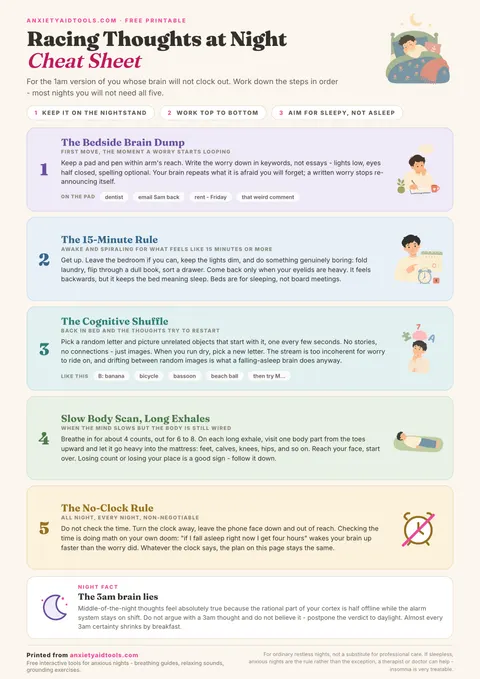
A one-page protocol for the moment it is 1am and your brain will not stop. Five steps in order, from the bedside brain dump to the no-clock rule, plus the truth about why 3am thoughts feel so convincing.
Unlock Downloads with Pro
Download high-resolution PDF (A4 & US Letter) and print-ready PNG formats for all cheat sheets directly from your dashboard.
Cheat sheets are one-page quick reference posters designed to be printed and kept where anxiety finds you. Available in A4, US Letter, and PNG formats in your Pro dashboard.
What's on this cheat sheet
The Bedside Brain Dump
Keep a pad and pen within reach and unload looping worries as keywords, not essays. A written worry stops re-announcing itself, because your brain repeats what it fears you will forget.
The 15-Minute Rule
Awake and spiraling past roughly 15 minutes? Leave the bed, keep lights dim, do something boring, and return only when sleepy. It protects the bed-equals-sleep link.
The Cognitive Shuffle
Picture random unrelated objects letter by letter: banana, bicycle, bassoon. The stream is too incoherent for worry to ride on, and it mimics how a falling-asleep brain naturally drifts.
Slow Body Scan, Long Exhales
Breathe in for about 4 and out for 6 to 8, letting one body part go heavy on each exhale, from toes to face. Losing your place is a good sign.
The No-Clock Rule
No time checks, all night. Checking the clock is doing math on your own doom, and the sleep arithmetic wakes your brain more than the worry did.
Night Fact: The 3am Brain Lies
A short explainer on why middle-of-the-night thoughts feel so true: the rational cortex is half offline while the alarm system stays on shift. Verdicts postponed to daylight shrink.
How to use it
- 1
Print the sheet and keep it on the nightstand with a pad and pen beside it.
- 2
When thoughts start racing, work the steps from the top; most nights you will not need all five.
- 3
Follow the no-clock rule the whole night, even between steps.
- 4
Aim for sleepy rather than asleep; drowsiness is the win, sleep follows on its own.
Frequently asked questions
How do I stop racing thoughts at night?
Do not try to argue the thoughts down; give them somewhere to go and then give your mind something better to hold. Start with a bedside brain dump: write each worry as a keyword or two, which stops it from re-announcing itself. Then occupy the mental channel with the cognitive shuffle or a slow body scan paired with long exhales, both of which are too absorbing and too calm for worry to ride along. If you have been spiraling for what feels like 15 minutes or more, get up, do something boring in dim light, and come back to bed sleepy.
Should I stay in bed if I can't sleep?
Usually not, once you have been awake and wound up for around 15 to 20 minutes. Lying in bed frustrated teaches your brain that the bed is a place for worrying, which makes the next night harder. Sleep specialists call the fix stimulus control: leave the bed, keep the lights dim, do something genuinely boring, and return only when your eyelids feel heavy. It feels counterproductive in the moment, but it protects the bed-equals-sleep association that makes falling asleep automatic.
Why does my anxiety get worse at night?
At night the distractions that normally dilute anxious thoughts disappear, so the worry channel gets the whole broadcast to itself. On top of that, the rational, evidence-weighing part of your brain powers down as you get sleepy, while the threat-detection system stays on duty, so worries feel more true and less answerable at 3am than they would at noon. Fatigue and the pressure of watching sleep slip away add fuel. That combination is why night anxiety responds better to a simple prepared protocol than to in-the-moment reasoning.
What is the cognitive shuffle?
The cognitive shuffle is a sleep technique developed by cognitive scientist Luc Beaudoin, sometimes called serial diverse imagining. You pick a letter and picture random, unrelated, emotionally neutral objects that start with it, one every few seconds: banana, bicycle, bassoon. Because the images have no storyline, worry has nothing to attach to, and the deliberate randomness resembles the loose, drifting imagery a brain naturally produces just before sleep. When one letter runs dry, you simply pick another and keep going until you drift off.