Coping with Grief Cheat Sheet
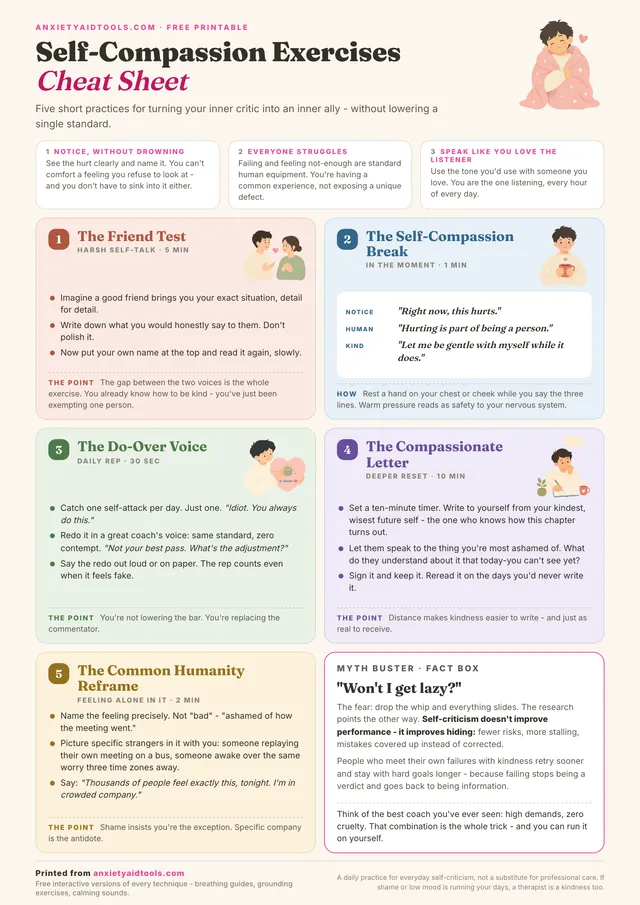
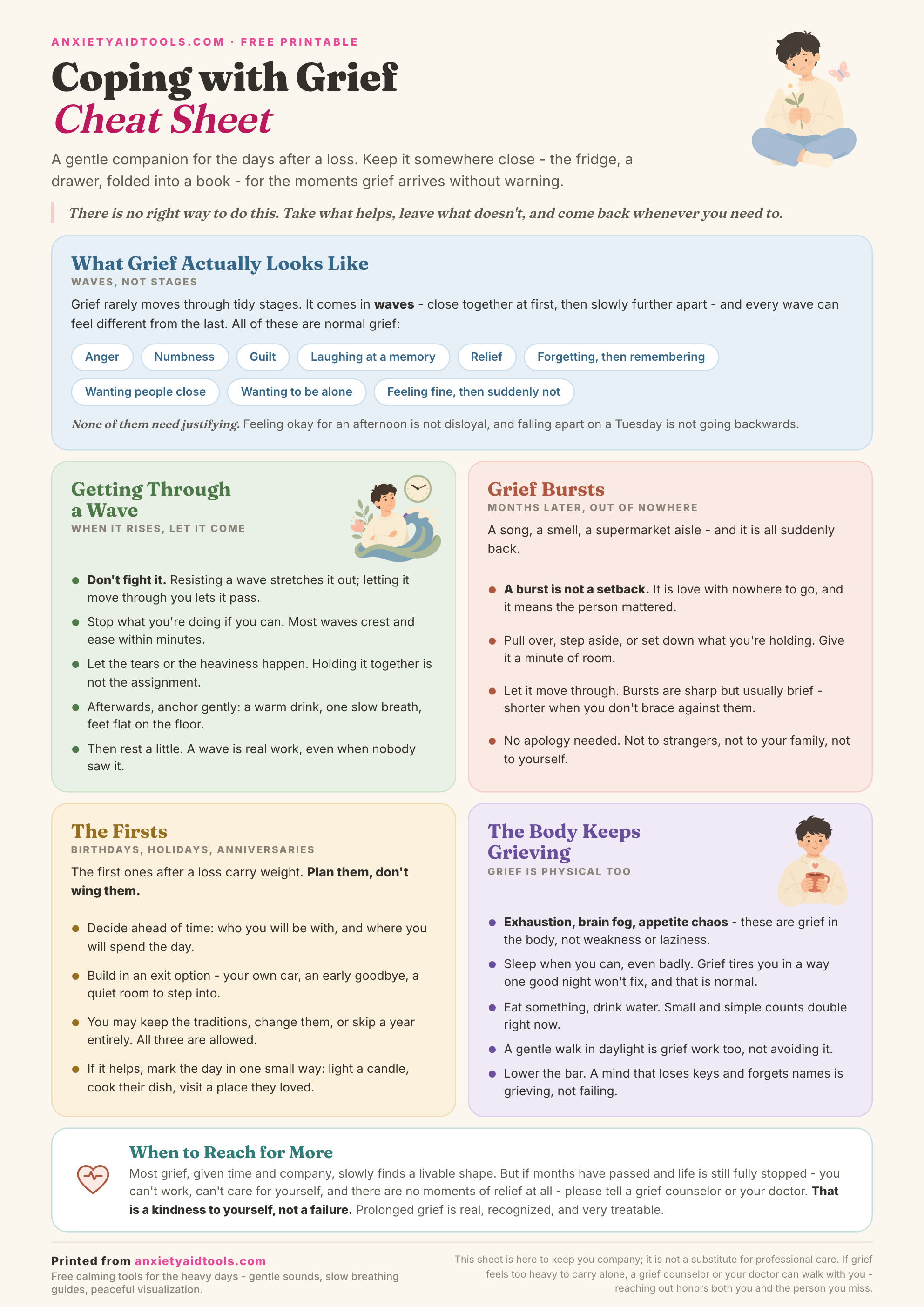
A warm one-page companion for the days after a loss. It covers grief waves, sudden grief bursts, planning the firsts, how grief lives in the body, and the gentle signs it may be time for more support.
Free download · PDF & PNG
Prints on one page - A4 and US Letter versions included
These cheat sheets are free for personal use, and therapists, counselors, and teachers are welcome to print and hand them out. Please keep the footer with the source on. If you share online, a link back to this page helps other people find the free version.
What's on this cheat sheet
What grief actually looks like
Waves, not stages: anger, numbness, laughing at a memory, and even relief are all normal grief, and none of them need justifying.
Getting through a wave
Let the wave come instead of fighting it, then anchor gently afterwards with a warm drink, one slow breath, and feet on the floor.
Grief bursts
For the ambush months later - a song, a smell, a supermarket aisle. A burst is not a setback; it is love with nowhere to go.
The firsts
Plan the first birthday, holiday, and anniversary instead of winging them: decide who you will be with, where, and an exit option ahead of time.
The body keeps grieving
Exhaustion, brain fog, and appetite chaos are physical grief. Sleep, water, food, and gentle walks count as grief work too.
When to reach for more
A gentle guide to the signs that grief counseling or a doctor visit would help, and why reaching out is a kindness, not a failure.
How to use it
- 1
Print it and keep it somewhere close - a drawer, the fridge, folded into a book you return to.
- 2
When a wave rises, read the wave section and let it move through instead of fighting it.
- 3
Before a first birthday, holiday, or anniversary, use the firsts section to plan the day ahead of time.
- 4
Revisit the last strip now and then; if life is still fully stopped months in, let it nudge you toward support.
Frequently asked questions
How long does grief last?
There is no timetable, and grief does not so much end as change shape. The waves usually come close together at first, then gradually spread out, with more livable days in between. Most people find a workable rhythm within a year or two, though a wave can still arrive years later and be completely normal. The love keeps its place; it just stops taking up every hour of the day.
Are the five stages of grief real?
The five stages describe experiences many grieving people recognize, but they were never meant as a required sequence, and research does not support grief moving through them in order. Most grief specialists now describe grief as waves that come and go, slowly spacing out over time. If your grief skips stages, repeats them, or ignores them entirely, nothing is wrong with you. There is no order to follow and no stage to fail.
Is it normal to feel relief or nothing at all when someone dies?
Yes, both are common, and neither means you loved the person less. Relief is especially frequent after a long illness or a hard caregiving season, because part of what ends is suffering. Numbness is often the mind taking in a loss gradually rather than all at once. Feelings tend to arrive later, in waves, once there is room for them.
When should I get help for grief?
Reach out if months have passed and life is still fully stopped: you cannot work, cannot care for yourself, and there are no moments of relief at all. Those can be signs of prolonged grief, which is a recognized and very treatable condition. A grief counselor, a support group, or a visit to your doctor are all good places to start. Asking for help with grief is a kindness to yourself, not a failure.