Gratitude Journal Prompts
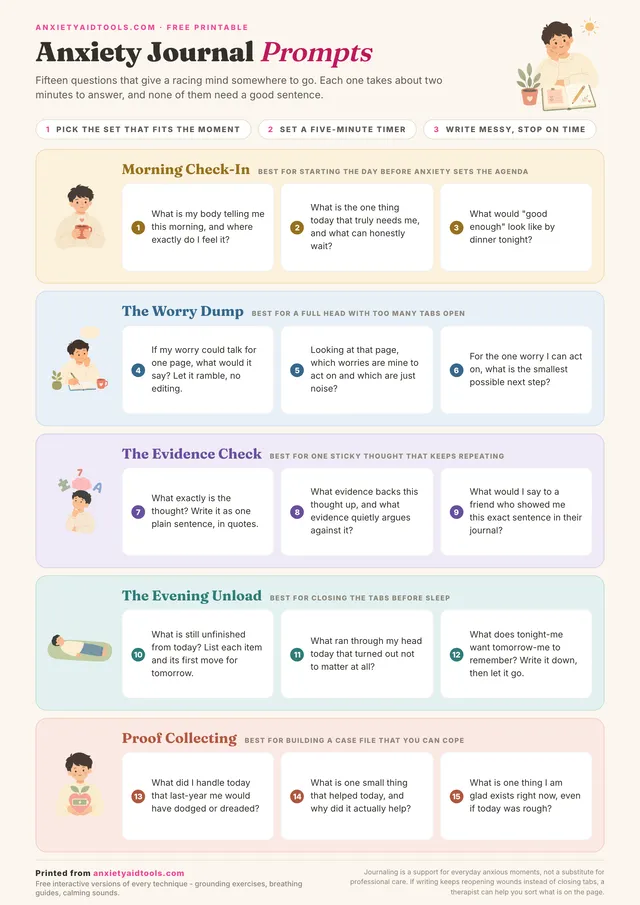
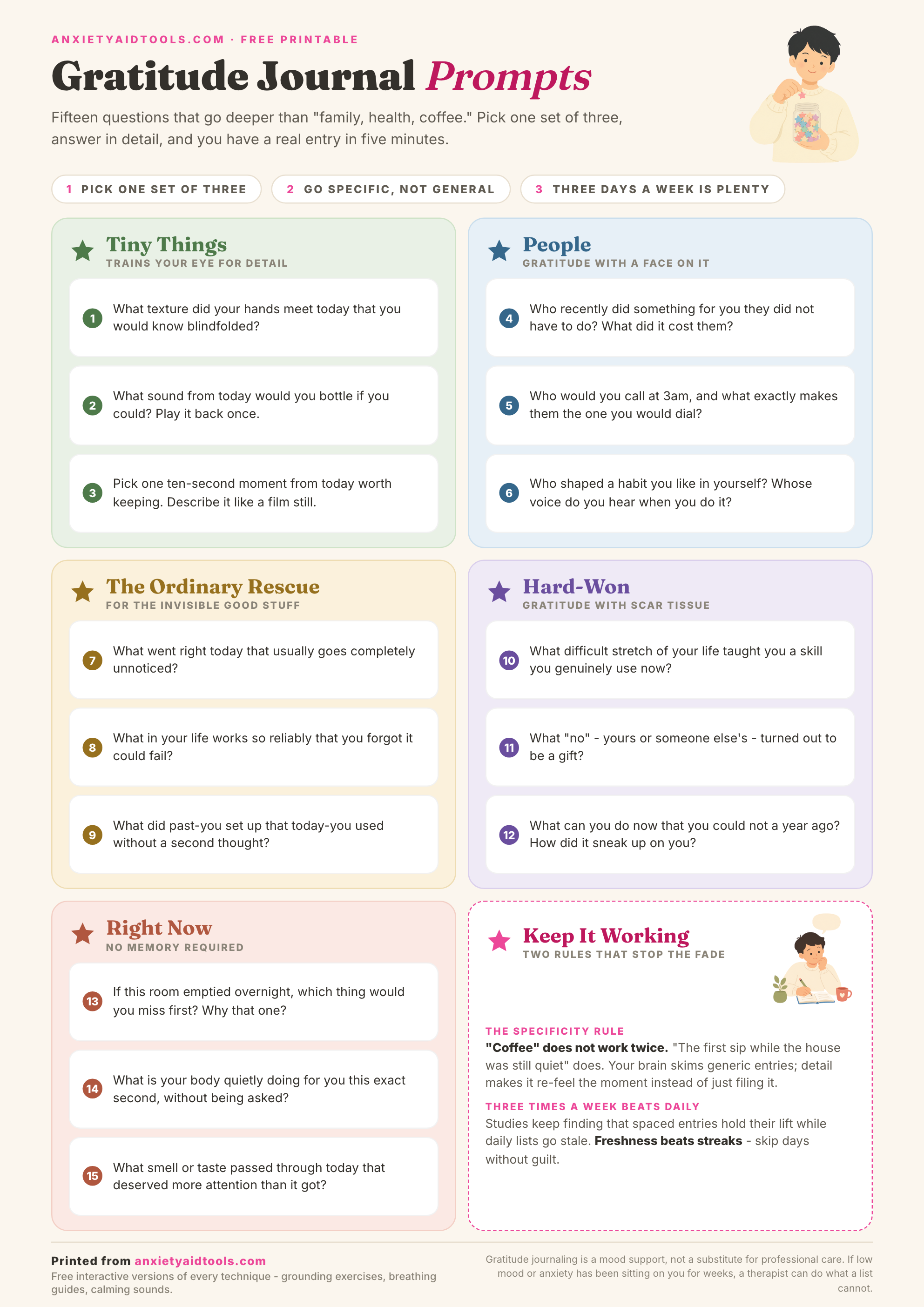
Fifteen gratitude prompts that go deeper than "family, health, coffee," organized into five sets of three. One set answered in detail is a full entry, and two research-backed rules keep the practice from going stale.
Free download · PDF & PNG
Prints on one page - A4 and US Letter versions included
These cheat sheets are free for personal use, and therapists, counselors, and teachers are welcome to print and hand them out. Please keep the footer with the source on. If you share online, a link back to this page helps other people find the free version.
What's on this cheat sheet
Tiny Things
Three prompts that train specific noticing: a texture your hands would recognize blindfolded, a sound worth bottling, and one ten-second moment from today described like a film still.
People
Gratitude with a face on it: who did something they did not have to do, who you would call at 3am and why them, and who shaped a habit you like in yourself.
The Ordinary Rescue
Prompts for the invisible good stuff: what went right today that usually goes unnoticed, what works so reliably you forgot it could fail, and what past-you set up that today-you used.
Hard-Won
Gratitude with scar tissue: a difficult stretch that taught you a real skill, a no that turned out to be a gift, and what you can do now that you could not a year ago.
Right Now
No memory required: what in this room you would miss first, what your body is quietly doing for you this second, and the smell or taste that deserved more attention today.
Keep It Working
Two rules that stop the fade: the specificity rule (generic entries stop working, detailed ones keep landing) and the finding that three entries a week beats a daily grind.
How to use it
- 1
Print the sheet and tuck it inside or next to your journal.
- 2
Pick one set of three prompts instead of working through all fifteen.
- 3
Answer in detail - one specific moment beats a list of ten generic items.
- 4
Write about three times a week and skip days without guilt; freshness beats streaks.
Frequently asked questions
Do gratitude journals actually work?
The honest answer: the effects are modest but real. Across studies, gratitude writing produces small to moderate improvements in mood and life satisfaction - meaningful, but not a cure for anxiety or depression. The effect is strongest under two conditions this sheet is built around: entries that are specific rather than generic, and sessions that are spaced out rather than forced daily. Think of it as one reliable tool in the kit, not the whole kit.
How often should I write in a gratitude journal?
Around three times a week, and possibly even less. Research on gratitude interventions has repeatedly found that spaced entries hold their benefit while daily writing tends to fade into a rote list, a pattern researchers link to hedonic adaptation: your brain stops responding to what it sees every day. So skipping days is not a failure of discipline, it is part of what keeps the practice working. If a daily streak motivates you, keep it, but vary the prompts so the answers stay fresh.
Why does my gratitude list feel fake?
Usually one of two reasons. First, the entries are too generic: writing "my family" for the tenth time produces no feeling because your brain skims what it has already filed. The fix is the specificity rule - name the exact moment, like the first sip of coffee while the house was still quiet. Second, you may be using gratitude to paper over something genuinely hard, which reads as fake because it is. Gratitude is noticing what is good alongside what is difficult, not instead of it; the Hard-Won set on this sheet exists for exactly that.
Is it better to do gratitude journaling in the morning or at night?
Whichever one you will actually do - consistency of moment matters more than the moment itself. That said, they do slightly different jobs. Evening entries let you harvest the day while it is still fresh, and some sleep research suggests a short gratitude reflection before bed can quiet pre-sleep worry. Morning entries prime you to notice good moments as they happen, which feeds the next entry. If you are torn, try evenings for two weeks: the Tiny Things and Right Now sets work best with a day behind you.