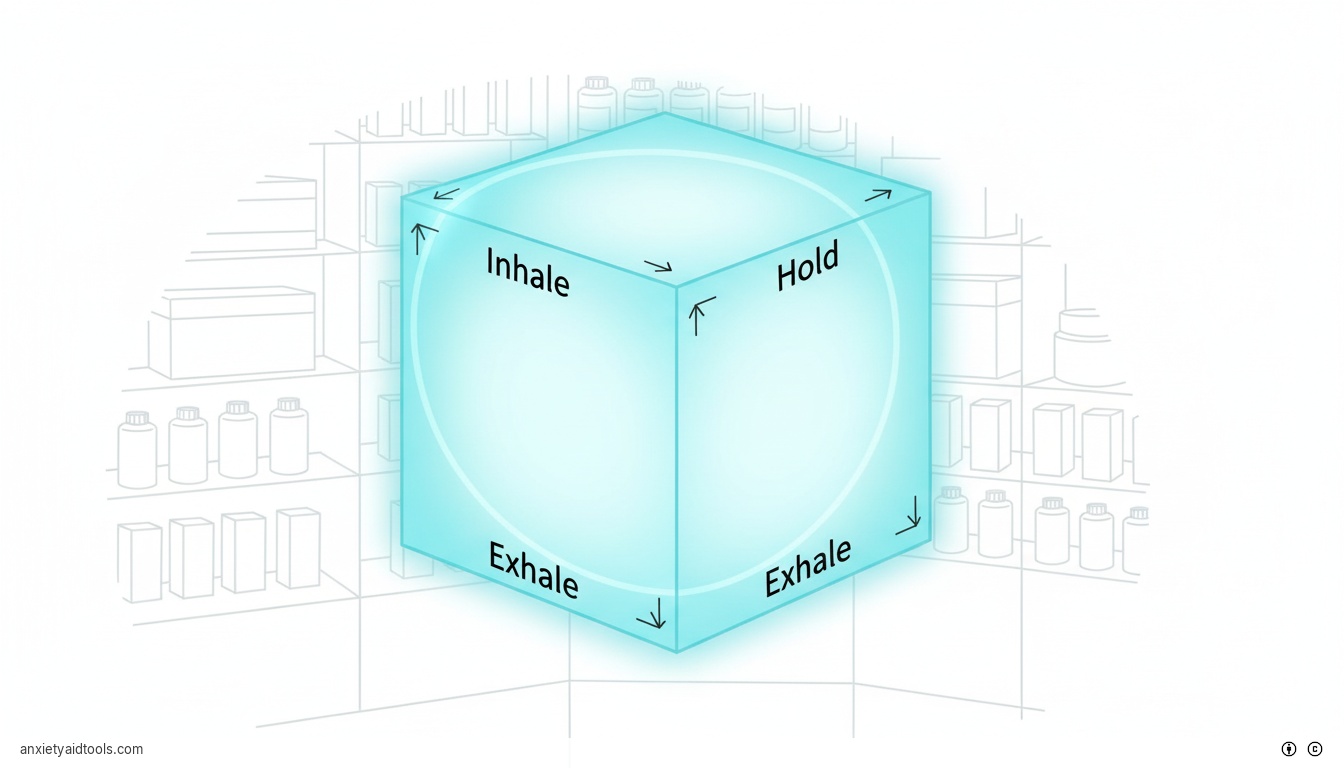
Navy SEALs cannot afford to panic. When their pulse spikes and tunnel vision sets in during a high-stakes operation, they don't rely on positive thinking to calm down. They use a physiological override switch. It is a simple, four-part breathing rhythm that forces the nervous system to shift from "fight or flight" to focus in a matter of minutes.
This technique is called Box Breathing. It requires no equipment, no quiet room, and it works immediately to cut through the noise and tell your body to settle down.
What Is Box Breathing?
Box breathing, sometimes called square breathing, is a form of paced respiration. The concept is simple. You break your breath cycle into four equal parts, like the four sides of a square.
Most of us breathe without thinking. When we get anxious, that automatic breathing changes. It becomes shallow. We gulp air. We breathe into our upper chest. This signals to the brain that we are in danger, which makes the physical symptoms of anxiety worse. It becomes a loop.
Box breathing breaks that loop. It forces you to take control of the rhythm. By regulating your breath, you regulate your nervous system.

The Four-Part Pattern
The practice follows a 4-4-4-4 count:
- Inhale for 4 seconds
- Hold air in for 4 seconds
- Exhale for 4 seconds
- Hold with empty lungs for 4 seconds
You repeat this cycle for several minutes until your heart rate slows and your mind clears. The symmetry is what makes it easy to remember. You don't need to count to seven or eight like in other techniques. It is just four even beats.
The Science: Why It Works
You might wonder how something so simple can have such a major effect on how you feel. The answer lies in how your lungs communicate with your brain.
When you are stressed, your body is in a state of high arousal. Your heart beats faster, and your blood pressure rises. This is your body preparing to fight or run. While this was helpful for our ancestors facing physical threats, it is less helpful when you are trying to type an email or sit through a difficult meeting.
Research shows that controlled breathing patterns directly affect this arousal level. A 2023 study tracked 108 participants over 28 days to see how different breathing techniques compared to mindfulness meditation. The results were clear. Participants who practiced box breathing for just five minutes a day saw a major improvement in positive mood and a reduction in physiological arousal. 1
The "Brake Pedal" Effect
Think of your nervous system like a car. Anxiety pushes the gas pedal. Controlled breathing hits the brakes.
When you extend your exhale and hold your breath, you stimulate the vagus nerve. This is a long nerve that runs from your brain to your abdomen. Activating it tells your body that you are safe. Your heart rate drops. Your muscles loosen.
Interestingly, the study mentioned above found that box breathing lowered respiratory rate effectively. While other techniques involving longer exhales (like cyclic sighing) were slightly more effective for physiological changes, box breathing provided a unique benefit: it helps with focus and mood regulation while still calming the body. 1

Step-by-Step Guide
If you are ready to try this, find a comfortable position. You can do this sitting in a chair, standing, or lying down. If you are sitting, try to keep your back straight and your feet flat on the floor.
1. Preparation
Exhale all the air out of your lungs. Do this through your mouth if you can, making a soft "whoosh" sound. You want to start on empty.
2. The Inhale (Side One)
Close your mouth and inhale quietly through your nose. Count slowly in your head: One... two... three... four. Focus on filling your belly first, then your chest. You want a full, deep breath, not a shallow one.
3. The Hold (Side Two)
Hold that breath. Do not clamp your mouth shut or tighten your throat. Just let the air sit in your lungs. Keep your body relaxed. Count: One... two... three... four.
4. The Exhale (Side Three)
Release the air through your mouth. Make it a smooth, steady stream. You want to be completely empty by the time you reach four. Count: One... two... three... four.
5. The Empty Hold (Side Four)
This is the part people often forget. Pause with your lungs empty. Stay in that stillness. Count: One... two... three... four.
6. Repeat
Start again with the inhale. Aim for at least four cycles, or keep going for five minutes.
Tip: If you find it hard to keep track, you can use a visual aid. Our stress relief bubbles or a fidget spinner visual can help you keep a steady rhythm while you breathe.
Why Navy SEALs Use It
The military connection is not just marketing. High-performance units like the Navy SEALs use this technique because they operate in environments where panic can be fatal. They refer to it as "Tactical Breathing."
In a high-stress situation, your fine motor skills degrade. Your hands might shake. Your tunnel vision kicks in. This makes tasks like aiming a weapon or reading a map difficult.
A study focusing on student officers showed that using tactical breathing helped mitigate stress responses during shooting tasks. The officers who used the technique maintained better shooting accuracy because they were able to stabilize their physiological arousal. 2
They use it because it creates a "reset" for the brain. It allows a soldier to move from a state of chaotic reaction to a state of focused action. You might not be on a battlefield, but the biological mechanism is the same. If you are about to give a public speech or enter a negotiation, your body reacts as if it is in danger. Box breathing brings you back to a place where you can perform.

Comparing Breathing Techniques
There are many ways to breathe for relaxation. You might have heard of 4-7-8 breathing or simple deep breathing. Box breathing is distinct because of the "holds."
Here is a quick breakdown of how it compares to other methods:
| Feature | Box Breathing | 4-7-8 Breathing | Mindfulness |
|---|---|---|---|
| Pattern | 4-4-4-4 | 4-7-8 | Natural |
| Goal | Focus + Calm | Deep Relaxation | Awareness |
| Best For | High stress situations | Sleep preparation | Daily practice |
| Effect | Regulates arousal | Sedating | Brain changes |
| Difficulty | Low | Medium | High |
A meta-analysis of various breathwork trials found that controlled breathing generally has a small-to-medium positive effect on lowering stress and anxiety compared to doing nothing. 3 However, box breathing is often preferred in active situations because it doesn't make you sleepy. The 4-7-8 method is excellent for sleep, but the long exhale can be sedating. Box breathing keeps you alert.
Common Challenges and Solutions
Even though the instructions are simple, doing it right takes some awareness. Here are a few things that might trip you up.
The "Air Hunger" Panic
When you hold your breath after exhaling, you might feel a sudden urge to gasp. This is called "air hunger." It happens because carbon dioxide is building up slightly in your blood. This is actually safe and part of why the technique works-it increases your tolerance to CO2, which can help reduce anxiety over time.
Solution: If 4 seconds feels too long, start with a 3-3-3-3 count. Do not force it. You should not feel dizzy. If you do, return to normal breathing immediately.
Tensing the Shoulders
Many people hike their shoulders up toward their ears when they inhale. This creates tension in the neck and prevents the diaphragm from moving fully.
Solution: Rest your hands on your lap. Visualize your shoulders melting down your back. If you need help relaxing your muscles first, you might try progressive muscle relaxation before starting your breathing practice.

Racing Thoughts
You start counting, but by the third side of the box, you are thinking about your grocery list or that email you forgot to send.
Solution: This is normal. Do not get angry at yourself. Just notice the thought and bring your attention back to the number. You can also try thought labeling to acknowledge the distraction without getting stuck in it.
Integrating It Into Your Life
The best thing about box breathing is its stealth. You can do it in a meeting, and no one will know. You can do it while driving (keep your eyes open, obviously). You can do it while waiting in line at the grocery store.
Here are three specific times to use it:
1. The "Threshold" Moment Before you walk through a door-whether it is your office door, your front door after a long day, or the door to a difficult appointment-stop. Do two rounds of box breathing. It clears the mental residue of whatever you were doing before, allowing you to be present for what comes next.
2. The Morning Jump-Start If you wake up with immediate anxiety about the day, stay in bed for two extra minutes. Perform the cycle. It sets a baseline of calm before you look at your phone.
3. The Focus Reset If you have been staring at a computer screen for hours and your brain feels foggy, step away. Do five minutes of box breathing. It increases oxygen flow and can help reset your attention span.
For those who struggle to sit still, you can combine this with physical grounding. Holding a tactile object can help anchor you while you breathe. A stress ball acts as a great physical anchor to squeeze rhythmically with your counts.

Why The "Hold" Matters
The magic of box breathing is in the pause.
In our busy lives, we rarely pause. We rush from inhale to exhale, from task to task. The hold forces us to stop.
Physiologically, holding your breath allows CO2 levels to rise slightly in the blood. This might sound bad, but it is actually helpful for anxiety. When we panic, we over-breathe (hyperventilate), blowing off too much CO2. This causes blood vessels to constrict, leading to lightheadedness. By holding the breath, you normalize blood gases and keep blood flowing properly to the brain.
Psychologically, the hold is a moment of suspension. It is a moment where you are doing nothing but existing. Learning to be comfortable in that pause-even for just four seconds-builds resilience. It teaches your brain that you can pause before reacting.
Moving Forward
Anxiety often feels like it is happening to you. It feels like an external force that crashes down. Techniques like box breathing remind you that you have access to the control panel. You can change your own physiology.
You do not need to be a Navy SEAL to benefit from this. You just need to be a human being who experiences stress. The next time you feel that tightness in your chest or that flutter of panic, remember the box.
Inhale. Hold. Exhale. Hold.
It is a simple square, but it builds a solid foundation for a calmer day.
If you are looking for more ways to manage stress, you might explore guided breathing exercises or read about grounding techniques that complement this practice well.
Frequently Asked Questions
How long does it take for box breathing to work?
Can I use box breathing for public speaking anxiety?
Why is the hold part of the square important?
What should I do if I get distracted while counting?
Is box breathing better than 4-7-8 breathing?
What if I cannot hold my breath for four seconds?
Research and References
Footnotes
- Balban MY, Neri E, Kogon MM, et al. Brief structured respiration practices enhance mood and reduce physiological arousal. Cell Rep Med. 2023 Jan 17;4(1):100874. Link: https://pubmed.ncbi.nlm.nih.gov/36630953/ ↩ ↩2
- Modarres M, Kholdi N, Sullman MJM. The effects of tactical breathing on shooting performance and physiological arousal. Ergonomics. 2021;64(8):1058-1069. Link: https://pubmed.ncbi.nlm.nih.gov/32757097/ ↩
- Fincham GW, Strauss C, Montero-Marin J, Cavanagh K. Effect of breathwork on stress and mental health: A meta-analysis of randomised-controlled trials. Sci Rep. 2023 Jan 9;13(1):432. Link: https://pubmed.ncbi.nlm.nih.gov/36624160/ ↩