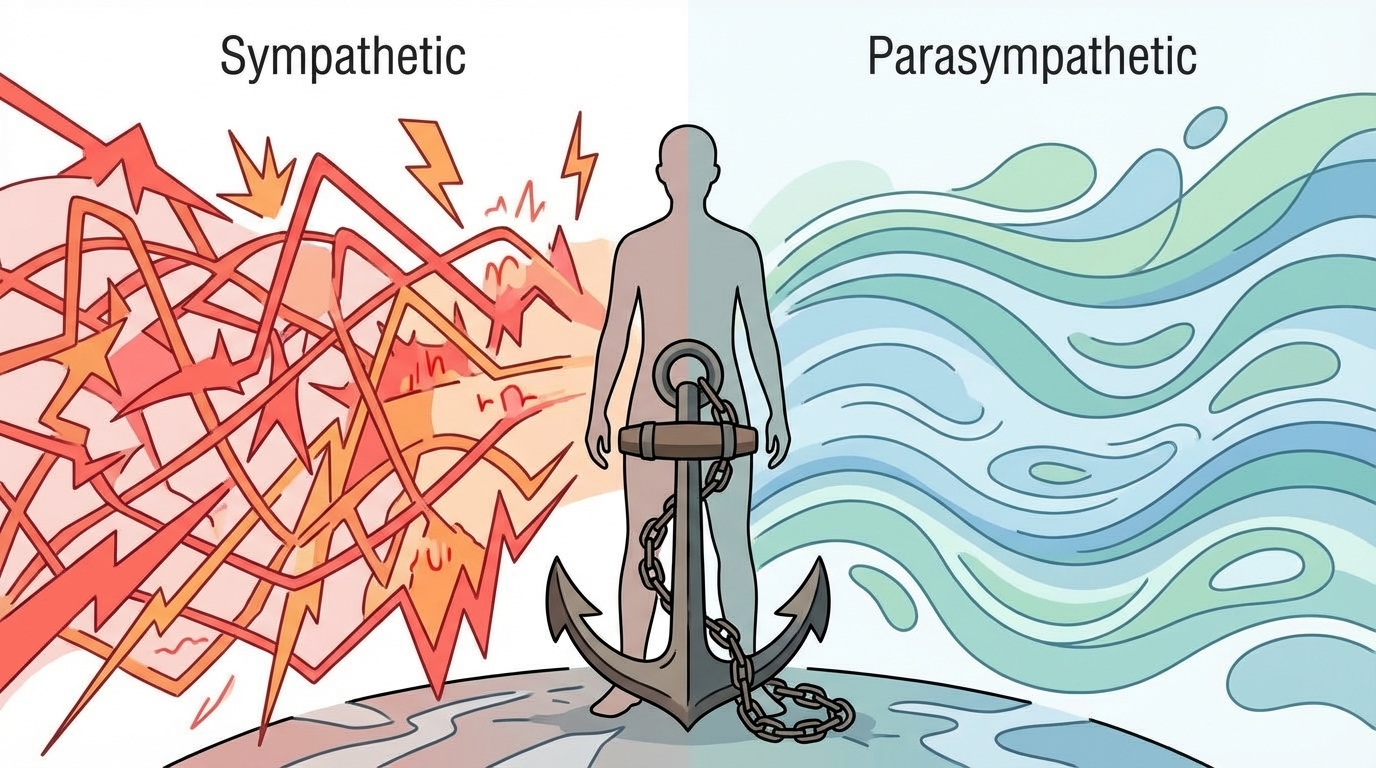
Anxiety often feels like you're losing touch with what's actually happening right now. Your mind might race ahead to worst-case scenarios or get stuck replaying old pain. This mental loop kicks off a physical reaction, making your body feel tense and on edge. Grounding techniques are a way to hit the brakes. They work by shifting your focus away from those stressful thoughts and bringing you back to where you are right now.

These techniques help your body switch gears from "fight or flight" mode back to a calmer state. By focusing on what you can see, hear, or touch, or by doing a simple physical action, you give your brain something real to focus on. This sends a clear message to your body that you are safe, helping the fear subside.
Studies looking at hundreds of people show that simple breathing exercises can significantly lower anxiety levels1. The methods below are quick, practical ways to find your footing again when stress hits hard.
1. The 5-4-3-2-1 Sensory Method

The 5-4-3-2-1 technique is arguably the most widely recognized grounding exercise because of its comprehensive engagement of the senses. It requires you to identify specific elements in your environment, forcing the brain to switch from internal rumination to external observation. Try the interactive 5-4-3-2-1 grounding exercise to practice this method in real time.
How It Works
The process involves identifying:
- 5 things you see: Look for small details, like a crack in the wall, the pattern of a rug, or the way light hits a surface.
- 4 things you can touch: Notice the texture of your clothing, the cool surface of a table, or the feeling of the floor beneath your feet.
- 3 things you hear: Listen for distant traffic, the hum of a computer, or birds outside.
- 2 things you can smell: This could be coffee, laundry detergent, or fresh air.
- 1 thing you can taste: If you cannot taste anything immediately, notice the inside of your mouth or take a sip of water.
The Scientific Impact
This method produces measurable physiological changes beyond simple distraction. In a pilot study regarding occupational stress, participants applying this technique for just two minutes experienced a 62% average drop in self-reported anxiety scores. The study also noted a 15-20% decrease in heart rate, attributed to enhanced vagal tone.
Long-term application shows major benefits as well. A randomized trial involving adults with generalized anxiety disorder found that practicing sensory-based exercises like this one reduced State-Trait Anxiety Inventory scores by 25-30% over four weeks. Furthermore, participants exhibited an 18% reduction in cortisol reactivity, indicating a shift in neural activity toward prefrontal regulation.
2. Progressive Muscle Relaxation (PMR)

Anxiety often causes unconscious muscle tightening. You might not realize your jaw is clenched or your shoulders are raised until pain sets in. Progressive Muscle Relaxation (PMR) addresses this by systematically tensing and then releasing muscle groups. This creates a feedback loop that lowers physical arousal. Walk through the full PMR exercise interactively to experience its full calming effect.
The Procedure
- Start at the bottom: Curl your toes downward tightly for 5-10 seconds.
- Release: Let go suddenly and feel the tension drain away. Wait 10 seconds.
- Move up: Tense your calf muscles, hold, and release.
- Continue upward: Work through thighs, buttocks, stomach, hands, arms, shoulders, and face.
Clinical Evidence
The efficacy of PMR is well-documented. A randomized controlled trial with burn patients showed that PMR over five days reduced Hamilton Anxiety Rating Scale scores by 43%, compared to only 15% in the control group2. This study linked the improvement to a 35% decrease in electromyographic muscle tension and a 28% improvement in sleep quality2.
In high-stress medical contexts, PMR proves highly effective. A trial involving COVID-19 patients demonstrated that 30-minute daily sessions lowered anxiety scores from 57.3 to 40.6, correlating with a 20-25% decline in inflammatory markers like C-reactive protein3. Similarly, nursing students undergoing clinical training saw a 38% reduction in state anxiety after intervention, driven by better emotional regulation4.
3. The 4-7-8 Breathing Technique

Controlled respiration is the fastest way to communicate with the vagus nerve. The 4-7-8 technique, developed to synchronize breathing with heart rate, acts as a natural tranquilizer for the nervous system. Try this breathing pattern in the guided breathing exercise, which also includes other effective ratios like 4-4-4-4 and 4-4-6.
Execution
- Inhale quietly through the nose for a count of 4.
- Hold the breath for a count of 7.
- Exhale forcefully through the mouth, making a "whoosh" sound, for a count of 8.
- Repeat this cycle at least four times.
The extended exhalation is the key component here. It prevents rapid hyperventilation and forces the heart rate to slow down.
Research Outcomes
Clinical trials support the potency of this specific ratio. A study on post-bariatric surgery patients revealed that using the 4-7-8 method twice daily for two weeks decreased State Anxiety Inventory scores by 35%5. This performance notably outpaced standard deep breathing, which showed lower efficacy.
In healthy adults, eight weeks of similar diaphragmatic breathing reduced cortisol levels by 23% following stress tasks6. Furthermore, a review of studies involving chronic conditions like COPD noted anxiety reductions of 25-40% after consistent practice, alongside improvements in breathing capacity7.
4. Physical Earthing (Grounding)

"Earthing" refers to making direct physical contact with the ground-grass, soil, sand, or conductive mats. The theory suggests that this contact facilitates the transfer of electrons from the earth to the body, neutralizing free radicals and dampening inflammation.
Application
- Outdoors: Walk barefoot on grass or sand for 20-30 minutes.
- Indoors: Use a grounding mat or simply touch a conductive surface that is grounded.
Biological Mechanisms
Research indicates that this physical connection alters body chemistry. A study using rat models found that daily use of earthing mats diminished anxiety-like behaviors by 40%8. This change correlated with normalized serotonin levels in the prefrontal cortex.
Human studies reflect these findings. A multi-disciplinary review showed that grounding could improve mood by 38% on the Profile of Mood States scale after just one hour9. Additionally, a 2024 synthesis of 20 studies indicated a 25-35% reduction in anxiety symptoms among populations with mood disorders, possibly due to reduced oxidative damage and immediate increases in heart rate variability10.
5. Cognitive Categories Game

When emotions run high, the emotional brain (limbic system) overpowers the logical brain (prefrontal cortex). Forcing your mind to categorize items requires logical processing, which helps dampen emotional reactivity.
How to Practice
Choose a category and name as many items as possible within that group for one minute.
- Categories: Movies starting with 'A', types of cereal, animals that swim, cities in Europe, or blue objects.
- Variation: Go through the alphabet, naming a food item for every letter.
This technique is effective because it is difficult to panic while trying to remember the name of a specific vegetable. It occupies the "working memory," leaving less processing power available for anxious thoughts.
6. Cold Water Shock (The Mammalian Dive Reflex)

Temperature changes can shock the system into a reset. Exposure to cold water triggers the mammalian dive reflex, a physiological response that instantly slows the heart rate and redirects blood flow to vital organs.
The Method
- Splash: Splash ice-cold water around the eyes and nose area of your face.
- Immerse: If possible, fill a bowl with ice water and hold your breath while dipping your face in for 15-30 seconds.
- Alternative: Hold an ice cube in your hand until it melts. The intense sensation focuses attention on the hand and away from panic.
This method provides an immediate physical jolt that breaks the loop of spiraling thoughts. It is particularly useful during the onset of a panic attack when cognitive methods might feel too difficult to initiate.
7. The "Clench and Release" (Simplified PMR)
If you are in a public setting where full Progressive Muscle Relaxation is not feasible, the "Clench and Release" offers a discreet alternative. This version focuses on the hands and arms, which are often the site of tension during stress.
Steps
- Make tight fists with both hands.
- Squeeze your arms against your side tightly.
- Inhale deeply and hold the tension for 5 seconds.
- Exhale and release the hands completely, letting them hang loose or rest on your lap.
- Focus intensely on the difference between the tension and the relaxation.
Repeated cycles of this discreet movement can help lower blood pressure and heart rate without drawing attention in a meeting or social gathering.
8. Rhythmic Walking

Walking is often automatic, but turning it into a grounding exercise requires conscious attention to the mechanics of movement. This combines physical activity with sensory awareness.
The Technique
As you walk, count your steps in rhythm with your breath.
- Cadence: Inhale for 4 steps, exhale for 4 steps. The guided breathing exercise includes this 4-4 rhythm alongside other synchronized breathing patterns.
- Sensation: Focus entirely on the sensation of the soles of your feet lifting and striking the ground.
- Notice: Pay attention to the shift in weight from your heel to your toe.
This rhythmic activity engages the cerebellum and motor cortex, helping to integrate brain function and reduce the feeling of being "scattered."
9. Anchoring Phrases
Anxiety often speaks in "what if" scenarios. Anchoring phrases counter this with "what is." These are factual, neutral statements about your current reality.
Examples
- "I am sitting in a chair. My feet are on the floor. The time is 2:00 PM."
- "I am safe right now. This feeling is uncomfortable and temporary."
- "My name is Name. I am in Location. I can handle this moment."
Repeating these facts internally or aloud helps bridge the gap between perceived danger and actual safety. It validates the present moment and dismisses the hypothetical disasters the mind is fabricating.
10. Math and Logic Puzzles

Engaging the analytical side of the brain creates a "cognitive load" that competes with anxiety for resources. The brain has a limited amount of working memory; filling it with numbers leaves little room for worry.
Exercises
- Countdown: Count backward from 100 by 7s (100, 93, 86, 79...).
- Multiplication: Pick a number and keep doubling it (2, 4, 8, 16, 32, 64...).
- Patterns: Look at a tiled floor or patterned wallpaper and try to count the shapes or trace the lines with your eyes.
This method is highly effective for stopping an anxiety spiral before it reaches peak intensity. The math task needs sufficient difficulty to require focus while remaining easy enough to avoid causing frustration.
Building a Grounding Strategy
Understanding these techniques is the first step; applying them effectively requires a strategic approach. Anxiety often makes it difficult to remember what to do in the moment. Therefore, it is helpful to practice these methods when you are calm. This builds "muscle memory" for your nervous system.
Start by selecting one physical method (like PMR or breathing) and one cognitive method (like the 5-4-3-2-1 technique). Practice them for five minutes daily. When stress arises, you will be able to deploy these tools automatically rather than struggling to recall instructions. If you prefer structured guidance, use the interactive grounding and progressive muscle relaxation exercises, or try basic breathing techniques as a daily foundation.
Consistency matters. As the research shows, regular application of these techniques-whether it is the 4-7-8 breathing or sensory grounding-leads to long-term reductions in baseline anxiety and cortisol levels. By integrating these practices into your daily routine, you create a buffer against stress, making it easier to remain stable when challenges arise.
Frequently Asked Questions
How quickly do grounding techniques work for anxiety?
What is the most effective grounding technique for panic attacks?
Can grounding techniques help with social anxiety?
How often should I practice grounding techniques?
Are grounding techniques safe for everyone?
Can children and teenagers use grounding techniques?
Do grounding techniques replace therapy for anxiety disorders?
Footnotes
- PMC US National Library of Medicine. Effectiveness of breathing techniques in anxiety management: A meta-analysis. https://pmc.ncbi.nlm.nih.gov/articles/PMC10741869/ ↩
- PubMed National Library of Medicine. Effect of progressive muscle relaxation on anxiety and sleep quality in burn patients. 2020. https://pubmed.ncbi.nlm.nih.gov/31862277/ ↩ ↩2
- PMC US National Library of Medicine. Effects of progressive muscle relaxation on anxiety and inflammatory markers in COVID-19 patients. 2020. https://pmc.ncbi.nlm.nih.gov/articles/PMC10844009/ ↩
- PMC US National Library of Medicine. The impact of progressive muscle relaxation on anxiety in nursing students. 2022. https://ncbi.nlm.nih.gov/pmc/articles/PMC9047807/ ↩
- PubMed National Library of Medicine. Efficacy of 4-7-8 breathing on anxiety in post-bariatric surgery patients. 2023. https://pubmed.ncbi.nlm.nih.gov/36480101/ ↩
- PMC US National Library of Medicine. Diaphragmatic breathing reduces cortisol and improves attention. 2017. https://pmc.ncbi.nlm.nih.gov/articles/PMC5455070/ ↩
- ResearchGate. Exploring 4-7-8 Breathing for Stress Relief and Improved Quality of Life in Chronic and Degenerative Diseases: A Scoping Review. 2023. https://researchgate.net/publication/394625657_Exploring_4-7-8_Breathing_for_Stress_Relief_and_Improved_Quality_of_Life_in_Chronic_and_Degenerative_Diseases_A_Scoping_Review ↩
- PMC US National Library of Medicine. The effects of grounding on anxiety-like behavior in rats. 2023. https://pmc.ncbi.nlm.nih.gov/articles/PMC9855809/ ↩
- PMC US National Library of Medicine. The effects of grounding (earthing) on inflammation, the immune response, wound healing, and prevention and treatment of chronic inflammatory and autoimmune diseases. 2015. https://pmc.ncbi.nlm.nih.gov/articles/PMC4378297/ ↩
- ESMED. Grounding and its effects on anxiety and mood disorders. 2024. https://esmed.org/MRA/mra/article/view/6024 ↩